In 2018 and 2019, the W. K. Kellogg Arabian Horse Library (WKKAHL) at Cal Poly Pomona presented an exhibit on the history of the California pottery Hagen-Renaker, Inc.

Since the exhibit has come to a close, after more than 18 months, I am sharing some of my photos and thoughts about it.
My interest in model horse figurines has led me (somewhat to my own surprise) into the field of equine history research. I am blessed to have one of the premier equine history resources in the world within driving distance: the W. K. Kellogg Arabian Horse Library at Cal Poly Pomona.
A little history: Cal Poly Pomona is located on land that used to be the home of millionaire cereal maker Will Keith Kellogg and his world-famous Arabian horses. In his quest to fulfill a childhood dream, Kellogg sought out the finest Arabian bloodlines of the day from the US and abroad to begin a breeding program at his winter home in Pomona, California. And in 1925, the W. K. Kellogg Arabian Horse Institute was founded.
The first time I visited WKKAHL, in early 2016, it was to look up information on some of the real local horses that artist Maureen Love (1922-2004) used to inspire her designs for the California pottery Hagen-Renaker, Inc. Hagen-Renaker is only a few minutes' drive from the CPP campus. I was pleased to see that WKKAHL had one of Maureen's most impressive works, the H-R "Nataf" Arabian stallion, on display.

The library staff asked about my subject matter; I pointed to "Nataf" in their display cabinet. I explained that the real horse Nataf had been foaled on the Kellogg Ranch property and owned by a local family, that the figurine had been designed by a local artist, and the big glossy white horse had been produced by a local family-owned business which was still operating today.
It turns out that the Horse Library is part of the University Library's Special Collections Unit, which focuses on local and regional history, of which Hagen-Renaker is a part.
After much discussion over many months about the connection between Hagen-Renaker's Arabian figurines and the Kellogg Ranch, and the importance of Hagen-Renaker's history as a local business, I introduced the head of Special Collections and Archives Katie Richardson, archivist Alexis Adkins, and assistant archivist Elizabeth Hernandez to Susan Renaker Nikas of Hagen-Renaker. They began brainstorming the idea of an exhibit on Hagen-Renaker history at WKKAHL. To my knowledge, the exhibit would be the first of its kind.
As curator of the exhibit, Elizabeth spent a great deal of time researching the history of Hagen-Renaker, Inc., its designers, and its importance in its own Southern California community. This represented a steep learning curve for the library staff, but they handled it splendidly. It was interesting from a collector's perspective to see how academics viewed this seemingly esoteric subject matter.


A plaque of W. K. Kellogg and two Arabian foals greets visitors.

When visitors walked through the Horse Library entrance, they saw a large display case with an assortment of Hagen-Renaker figurines on the left. It was very difficult to get good photos of the shelves because of the glare from the glass.


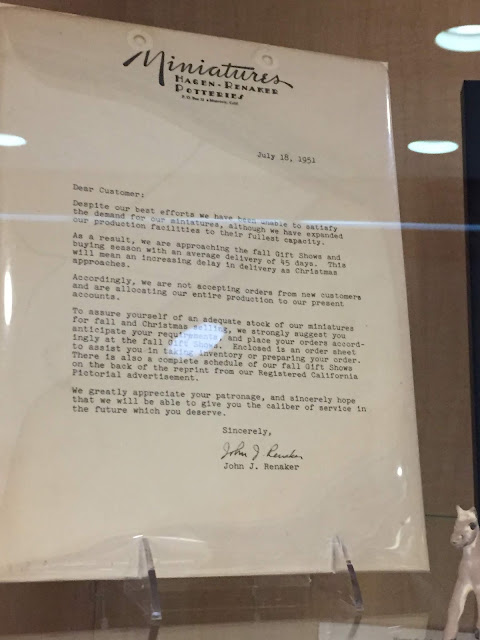
Down the corridor towards the Horse Library itself, a sharp right turn, and the rest of the outside display cases held more Hagen-Renaker treasures. The first part of this section of the exhibit focused on family history and examples of the company's early work, from dishes to ducks.




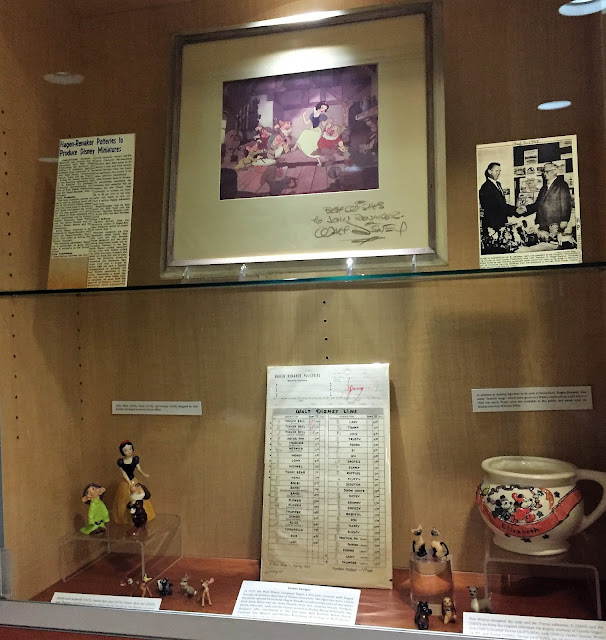
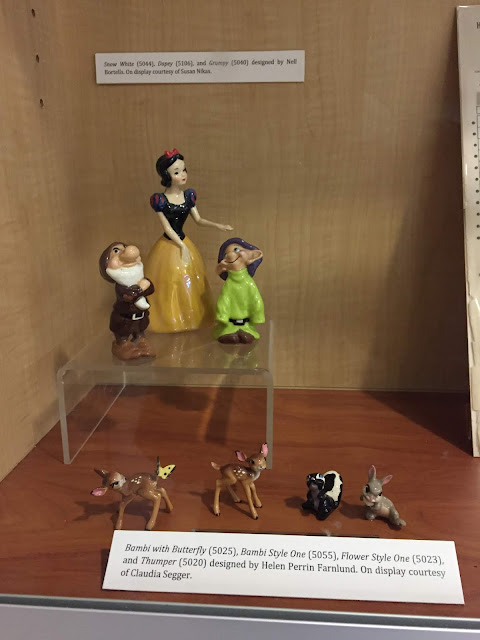
One of the most popular parts of the exhibit was the section on licensed Disney figurines.




The next display case showcased designer Maureen Love's equine art and the connection between her Arabian horse figurines and the Kellogg Ranch.


The next section of the exhibit showcased the work of designer Helen Perrin Farnlund.


The work of Tom Masterson, best known for his dog designs, came next.


The whimsical designs of Nell Bortells completed this section of the exhibit. She was responsible for the wildly popular 1950s "Little Horribles" figurines.


Inside the Horse Library, the exhibit continued. On one side of the door, a display case showed examples of Hagen-Renaker horses, Breyer reproductions, and some designs from Japanese ceramics manufacturers that competed with H-R.

On the other side of the main Horse Library door, another display case showed recent developments in the history of Hagen-Renaker, as well as information on the Collectors Club.


Finally, a long, low display case provided detailed information about the design and production process.

The end of the exhibit showed the Hagen-Renaker production process from start to finish.


While the exhibit was up, many model horse collectors were able to see it. Two large groups of collectors in Southern California for Clinky Mayhem 2018 were among the first visitors. We started out across campus at the W. K. Kellogg Arabian Horse Center....

And met some of the current Kellogg Arabians.


The Library staff displayed some of their archival materials for the collector groups, including this photo and other material on the real Kellogg Arabian Nataf, who inspired Maureen Love's enormous ceramic design.

Sue Nikas of Hagen-Renaker donated a number of figurines to WKKAHL as a fundraiser. The Horse Library sold them to the visiting model horse collectors and to CPP students.
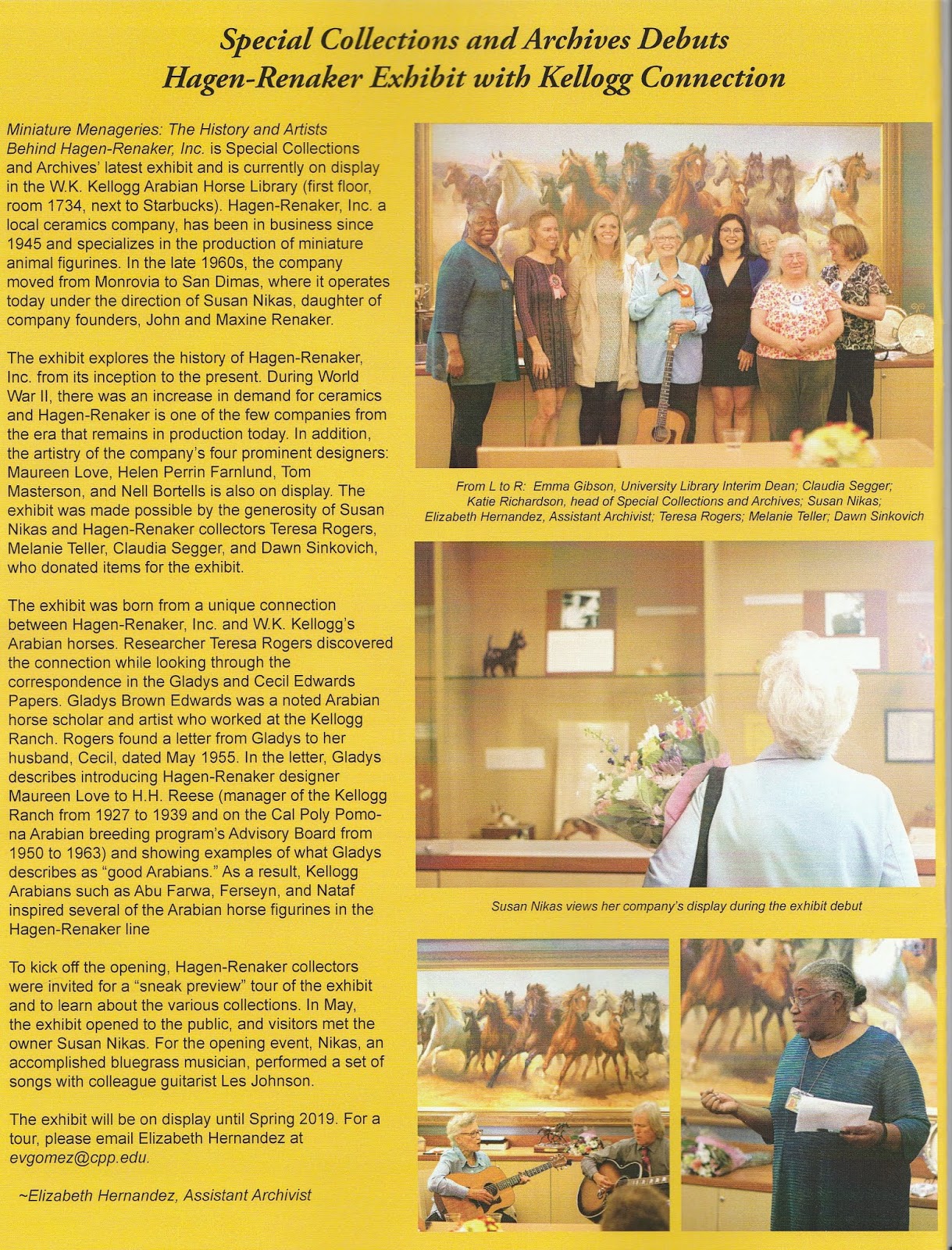
A gala grand opening for the exhibit was held on May 11, 2018. Dozens of people from the local community attended, along with model horse collectors Claudia Segger, Melanie Teller, Dawn Sinkovich of Share the Love, Lisa Dare, Heather and Michael Wells, and myself. Sue Nikas performed some of her original music with guitarist Les Johnson. The event was profiled in a Cal Poly Pomona University publication.


In fall 2018 and 2019, scholars who attended the annual Equine History Conference at Cal Poly Pomona also viewed the exhibit. It turned out that many of the horse history experts also owned model horses.


I presented a paper on the connection between Maureen Love, Hagen-Renaker, and the Kellogg Arabians at the 2018 Equine History Conference. I used the Hagen-Renaker large "Amir" Arabian stallion, and Maureen's original sketch of Abu Farwa that I own, as props during the presentation. I also wrote an article on this subject, mentioning the exhibit, for Arabian Horse Life magazine.

Cal Poly Pomona students were given tours of the Hagen-Renaker exhibit by WKKAHL staff, and many younger students visiting the CPP campus to learn about going to college, also saw the H-R exhibit.
The W. K. Kellogg Arabian Horse Library used materials from the Hagen-Renaker exhibit in its social media. A picture of the H-R miniature "Seabiscuit" by Maureen Love was used to celebrate the birthday of the plucky Thoroughbred race horse who raced at Santa Anita. A photo of a Hagen-Renaker "Abu-Farwa" helped the Library celebrate the National Day of the Horse. A group shot of the four Hagen-Renaker Persian cats, huge to tiny, was used to celebrate National Cat Day.
And this montage of images helped the Library celebrate the birthday of author Marguerite Henry.


Local families attended and/or participated in horse shows most weekends of the year. Local communities planned and held parades that featured horses of many breeds, as well as ponies, mules, and donkeys ridden by local adults and children as well as local elected officials and entertainment celebrities.
My interest in model horse figurines has led me (somewhat to my own surprise) into the field of equine history research. I am blessed to have one of the premier equine history resources in the world within driving distance: the W. K. Kellogg Arabian Horse Library at Cal Poly Pomona.
A little history: Cal Poly Pomona is located on land that used to be the home of millionaire cereal maker Will Keith Kellogg and his world-famous Arabian horses. In his quest to fulfill a childhood dream, Kellogg sought out the finest Arabian bloodlines of the day from the US and abroad to begin a breeding program at his winter home in Pomona, California. And in 1925, the W. K. Kellogg Arabian Horse Institute was founded.
The Kellogg Ranch became a popular destination for
celebrities and the general public to visit rare Arabian horses, and Kellogg Arabians appeared in
several feature films. A horse show was established on Sundays to showcase the
popularity and versatility of the Arabian horse.
W. K. Kellogg presented his ranch to the University of California in 1932. During World War II, use of the ranch was transferred to the U.S. Army as a facility for breeding war horses, and the Kellogg Ranch became the Pomona Quartermaster Depot (Remount) in 1943. The Army stopped breeding horses in 1948, and much of the ranch’s best stock— including Arabian horses—was dispersed around the country. The fate of the property was uncertain. In 1949, after much debate, the large Kellogg Ranch property once again became part of the state of California’s university system.
 |
| Silent screen star Rudolph Valentino on the Kellogg Arabian stallion Jadaan. They starred together in the film "The Son of the Sheik." |
 |
| Jadaan's saddle is on display at WKKAHL. |
W. K. Kellogg presented his ranch to the University of California in 1932. During World War II, use of the ranch was transferred to the U.S. Army as a facility for breeding war horses, and the Kellogg Ranch became the Pomona Quartermaster Depot (Remount) in 1943. The Army stopped breeding horses in 1948, and much of the ranch’s best stock— including Arabian horses—was dispersed around the country. The fate of the property was uncertain. In 1949, after much debate, the large Kellogg Ranch property once again became part of the state of California’s university system.
The first time I visited WKKAHL, in early 2016, it was to look up information on some of the real local horses that artist Maureen Love (1922-2004) used to inspire her designs for the California pottery Hagen-Renaker, Inc. Hagen-Renaker is only a few minutes' drive from the CPP campus. I was pleased to see that WKKAHL had one of Maureen's most impressive works, the H-R "Nataf" Arabian stallion, on display.

The library staff asked about my subject matter; I pointed to "Nataf" in their display cabinet. I explained that the real horse Nataf had been foaled on the Kellogg Ranch property and owned by a local family, that the figurine had been designed by a local artist, and the big glossy white horse had been produced by a local family-owned business which was still operating today.
 |
| A magazine ad for the real Nataf. Keep reading to see a couple more photos of him. |
It turns out that the Horse Library is part of the University Library's Special Collections Unit, which focuses on local and regional history, of which Hagen-Renaker is a part.
After much discussion over many months about the connection between Hagen-Renaker's Arabian figurines and the Kellogg Ranch, and the importance of Hagen-Renaker's history as a local business, I introduced the head of Special Collections and Archives Katie Richardson, archivist Alexis Adkins, and assistant archivist Elizabeth Hernandez to Susan Renaker Nikas of Hagen-Renaker. They began brainstorming the idea of an exhibit on Hagen-Renaker history at WKKAHL. To my knowledge, the exhibit would be the first of its kind.
As curator of the exhibit, Elizabeth spent a great deal of time researching the history of Hagen-Renaker, Inc., its designers, and its importance in its own Southern California community. This represented a steep learning curve for the library staff, but they handled it splendidly. It was interesting from a collector's perspective to see how academics viewed this seemingly esoteric subject matter.
Local collectors Melanie Teller, Claudia Segger, and I loaned pieces from our collection for the exhibit, to complement the many outstanding examples provided by Sue from Hagen-Renaker.
And if you were wondering, yes, loaning your prized collectible figurines/childhood friends for an exhibit dozens of miles from your house is a big leap of faith. (I figured that my own H-Rs were probably safer in the hands of professional archivists inside a temperature-controlled environment behind glass, than at my own home. Plus, this was shaping up to be an unprecedented part of model horse hobby history!)
And if you were wondering, yes, loaning your prized collectible figurines/childhood friends for an exhibit dozens of miles from your house is a big leap of faith. (I figured that my own H-Rs were probably safer in the hands of professional archivists inside a temperature-controlled environment behind glass, than at my own home. Plus, this was shaping up to be an unprecedented part of model horse hobby history!)

These examples show that the phrase "Hagen-Renaker Persian cat" can have different meanings.


Here are Melanie's "Ching Wu" and Claudia's original Maureen Love sketches from life of the real Siamese. We set the figurine on a napkin to protect him for the photo, which was taken before the exhibit was installed.

The exhibit opened in May 2018.

When visitors approach WKKAHL, inside the University Library (next to Starbucks), this is what they see.

When visitors approach WKKAHL, inside the University Library (next to Starbucks), this is what they see.

A plaque of W. K. Kellogg and two Arabian foals greets visitors.

When visitors walked through the Horse Library entrance, they saw a large display case with an assortment of Hagen-Renaker figurines on the left. It was very difficult to get good photos of the shelves because of the glare from the glass.
 |
| "King Cortez" stallion in palomino |


 |
| The first of Nancy Kelly's books on Hagen-Renaker. |
 |
| Heidi's goat, miniature penguin, frog. |
 |
| Designers Workshop "Rajah" elephant. |

 |
| Hagen-Renaker company photo of dogs designed by Tom Masterson. |
 |
| Rare test mold "Girl with Foal," designed by Maureen Love but never released for sale. Cast in 1969, it was painted recently. |
 |
| Designers Workshop deer family. It's somewhat rare to see the buck with intact horns! |


 |
| In the photo, Tom Masterson, Maureen Love, and Helen Perrin (Farnlund) look at Maureen's prototype donkey designs. My recent research dates the picture to 1953. |
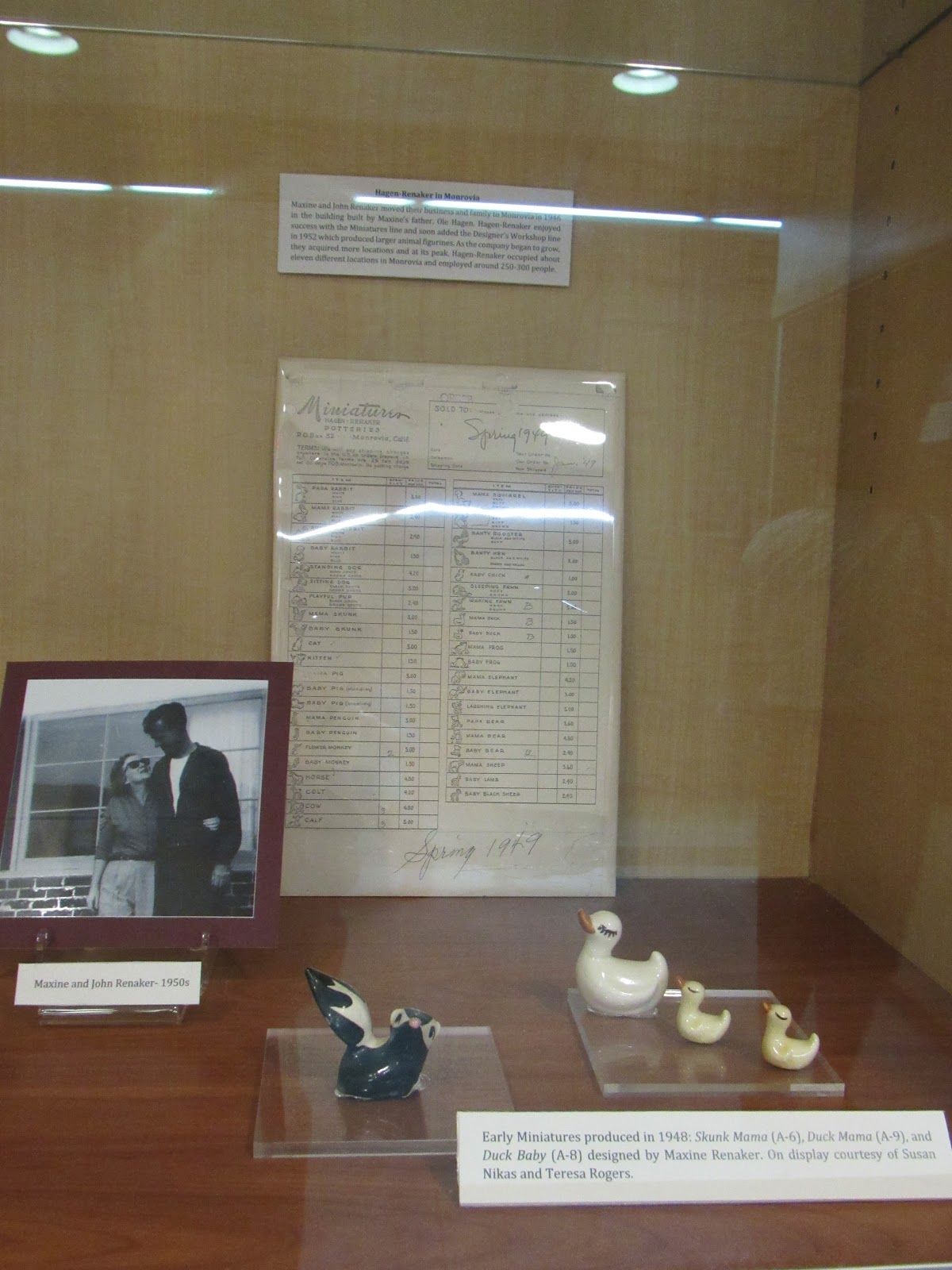
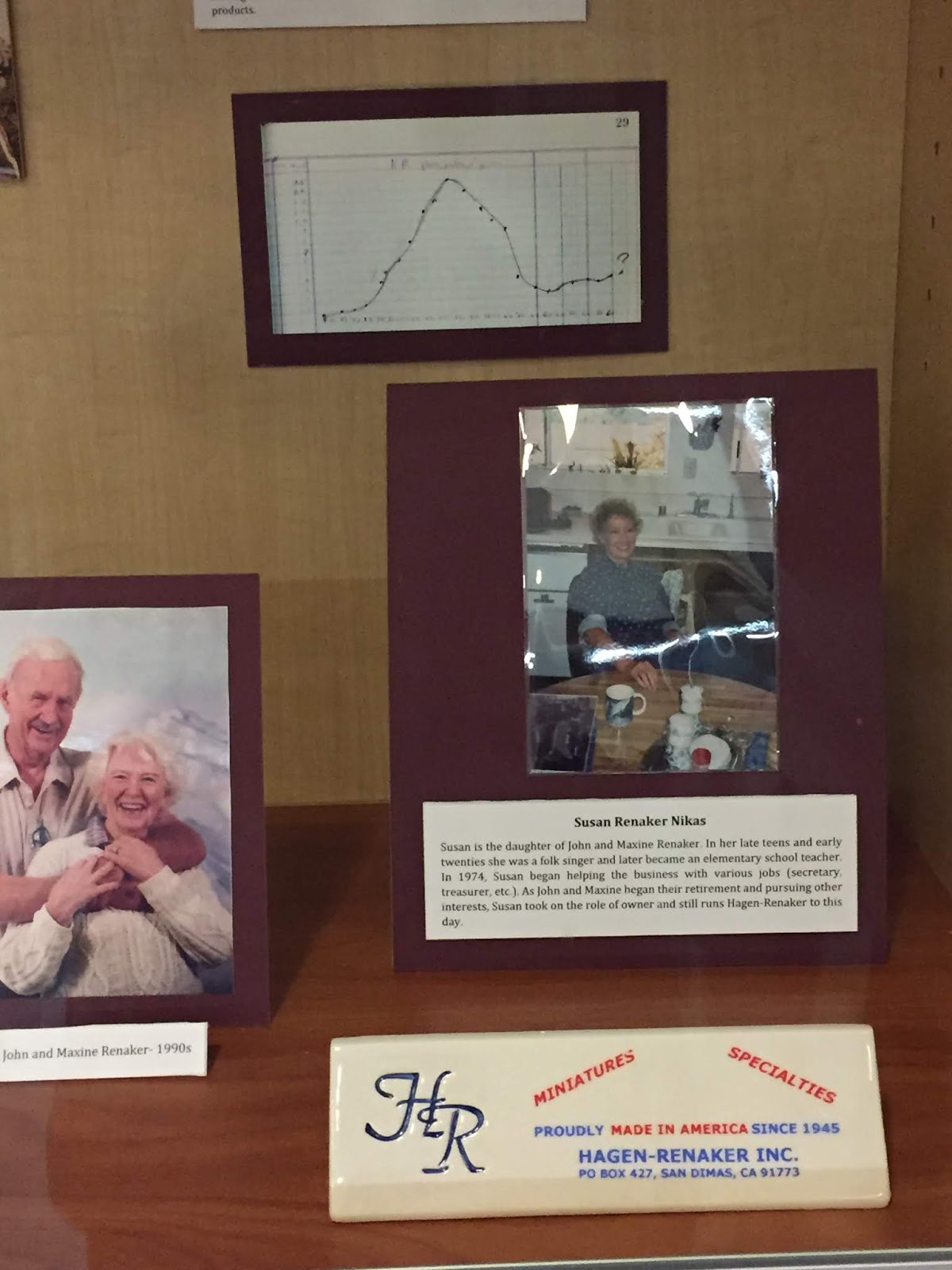
Down the corridor towards the Horse Library itself, a sharp right turn, and the rest of the outside display cases held more Hagen-Renaker treasures. The first part of this section of the exhibit focused on family history and examples of the company's early work, from dishes to ducks.
 |
| John Renaker, Jr. and Maxine Hagen Renaker. |


 |
| Visiting collectors gasped when they saw this tiny duck figurine. It was the first Hagen-Renaker animal figurine, designed by Maxine Renaker. THE actual Duck! |
 |
| These unfinished early H-R animals were fished out of a company trash bin by a Monrovia schoolgirl around 1949-1950. She kept them all these years, and gave them to me for the exhibit. |


 |
| Designers Workshop Quail, mounted at the factory on a redwood base for stability. |
 |
| I took a picture of this newspaper ad showing the three Morgan yearlings "Drum Major," "Mischief," and "Sky Chief" before a copy was added to the exhibit. |


 |
| San Dimas era "Terrang" Thoroughbred, designed by Maureen Love. The real Terrang ran at Southern California race tracks. |


One of the most popular parts of the exhibit was the section on licensed Disney figurines.


 |
| The Monrovia News-Post gave extensive coverage to Hagen-Renaker. |


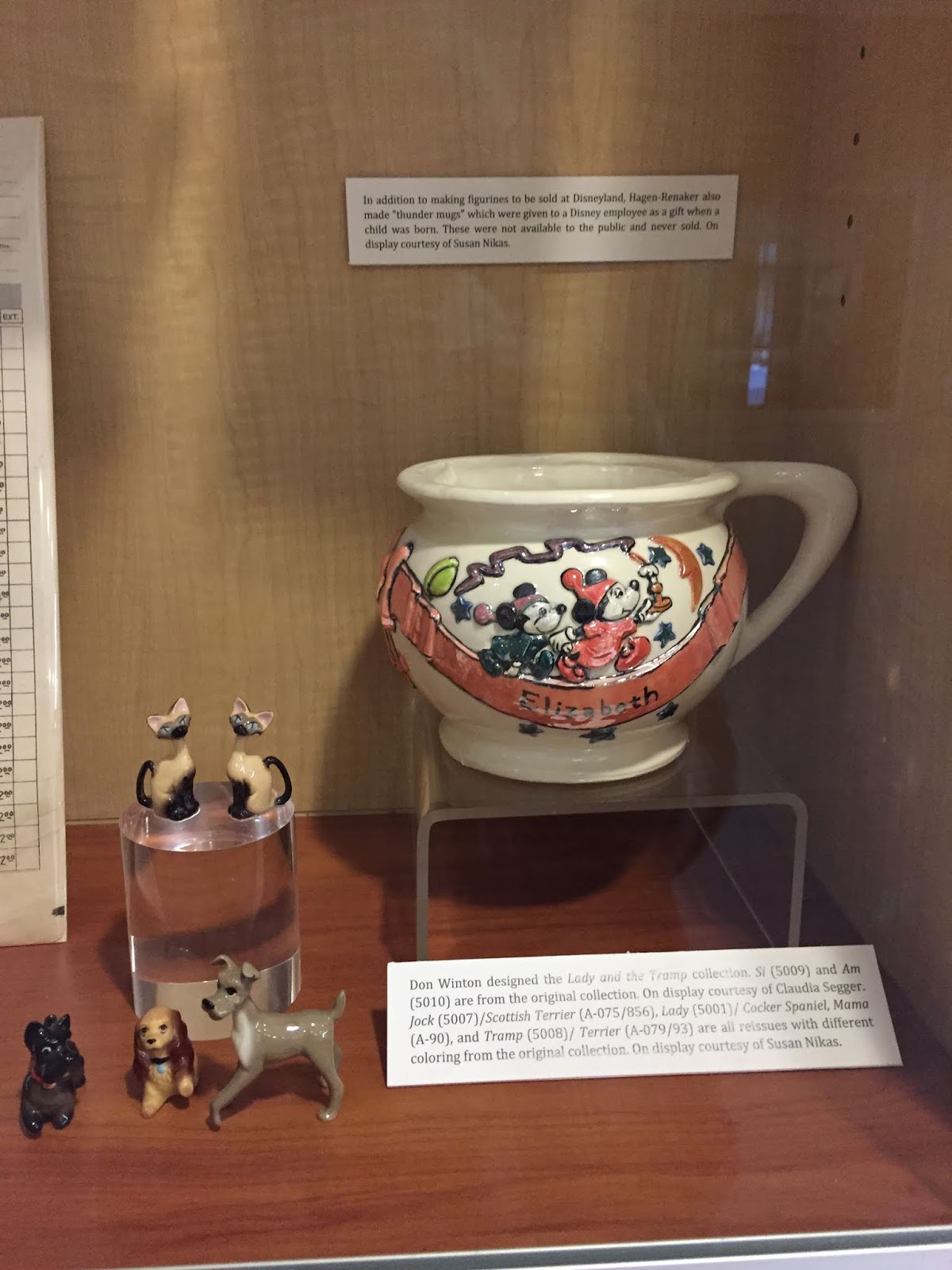 |
| Well-known Southern California potter Don Winton's "Lady and the Tramp" designs for Hagen-Renaker. |


The next display case showcased designer Maureen Love's equine art and the connection between her Arabian horse figurines and the Kellogg Ranch.
 |
| At some point during the exhibit, the horses on the left and right sides of the lower display case were relocated. This picture was taken a few days before the exhibit officially opened. |
 |
| "Misty of Chincoteague" |
 |
| The real Arabian stallion Nataf was foaled on the Kellogg Ranch property in 1948, when it was being used as a facility for breeding war horses by the US Army. |
 |
| The center of the exhibit featured a brief biography of Maureen Love. |
 |
| Maureen Love's sketches of the real Southern California horses that inspired her designs for Hagen-Renaker were reproduced by Share the Love and used in the displaywith permission. The real Morgan stallion Lippitt Morman was owned by Monrovia horse rancher Merle Little. Keep reading to see a photo of them. |
 |
| The Arabian stallions Ferseyn and Abu Farwa (who was chestnut in real life) were owned by former Kellogg Ranch manager Herbert H. Reese when Maureen Love sketched them and then created designs for Hagen-Renaker. Abu Farwa was foaled at the Kellogg Ranch in 1940; Ferseyn, son of the senior stallion at the Kellogg Ranch, *Raseyn, was conceived at the Kellogg Ranch before his dam, *Ferda, was sold. |
 |
| The real Ferseyn, in the Western Livestock Journal. Ferseyn's sire was the senior stallion at the Kellogg Ranch, *Raseyn. |
 |
| The real Abu Farwa, also from the WLJ. |
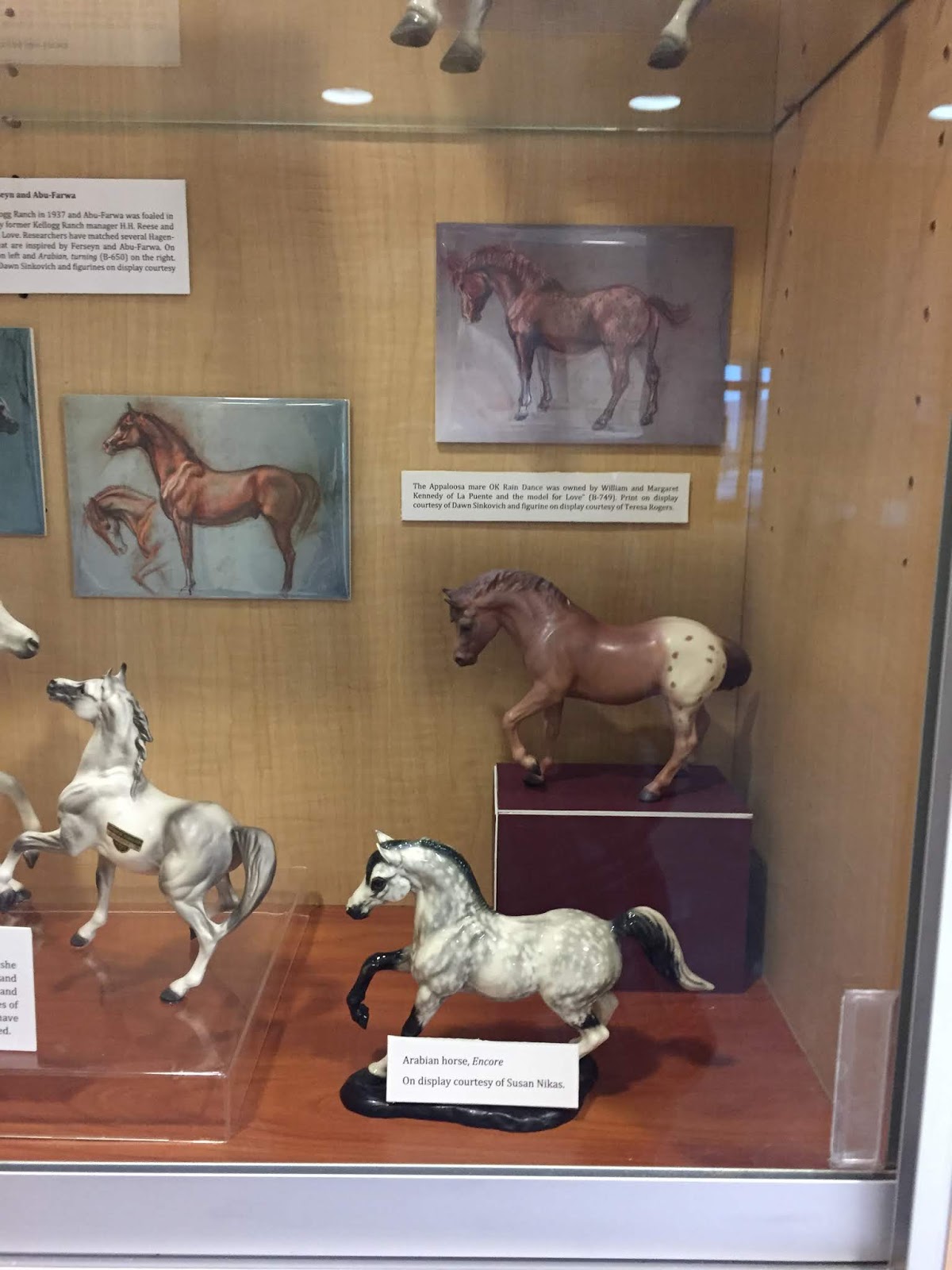 |
| The young Appaloosa mare OK Rain Dance was owned by local horse lovers William and Maggie Kennedy when Maureen Love sketched her. |

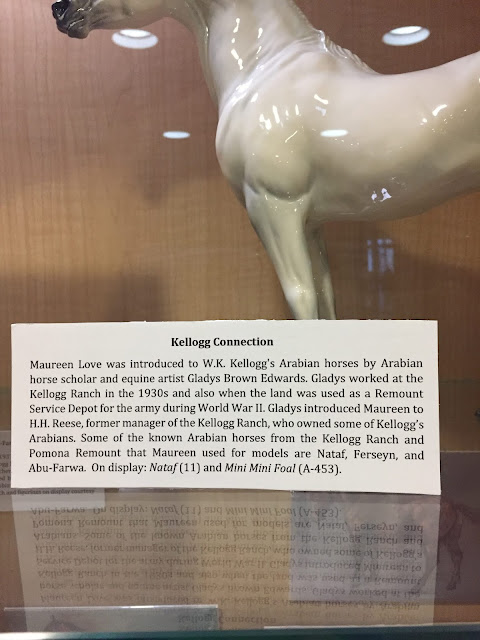 |
| This photo shows the exhibit's description of how Maureen Love was introduced to Herbert H. Reese's Arabians by author and artist Gladys Brown Edwards. |

 |
| Maureen Love's design of the Arabian "Encore" greatly resembles her earlier model based on Abu Farwa, that H-R did not use. |


 |
| Helen's large, intricate "Puss in Boots" was one of the highlights of the exhibit. |


The work of Tom Masterson, best known for his dog designs, came next.

 |
| Top: "Mac" the Scottish Terrier and "Bonnie" the Collie. Bottom: "Sherlock" the Basset Hound, Springer Spaniel, German Shepherd "Von," "Bruce" the Boxer and Dachshund. |


The whimsical designs of Nell Bortells completed this section of the exhibit. She was responsible for the wildly popular 1950s "Little Horribles" figurines.

 |
| Lord and Lady Bugs. |
 |
| Whitewasher, or Tom Sawyer, never sold to the public. |
 |
| Zany Zoo Lion. |


Inside the Horse Library, the exhibit continued. On one side of the door, a display case showed examples of Hagen-Renaker horses, Breyer reproductions, and some designs from Japanese ceramics manufacturers that competed with H-R.
 |
| The tiny H-R mini mini Arab mare was replicated as a silvertone brooch by a costume jewelry maker. |
 |
| That stunning example of the Breyer Classic "Man O' War" on the left belongs to Melanie Teller. |

On the other side of the main Horse Library door, another display case showed recent developments in the history of Hagen-Renaker, as well as information on the Collectors Club.


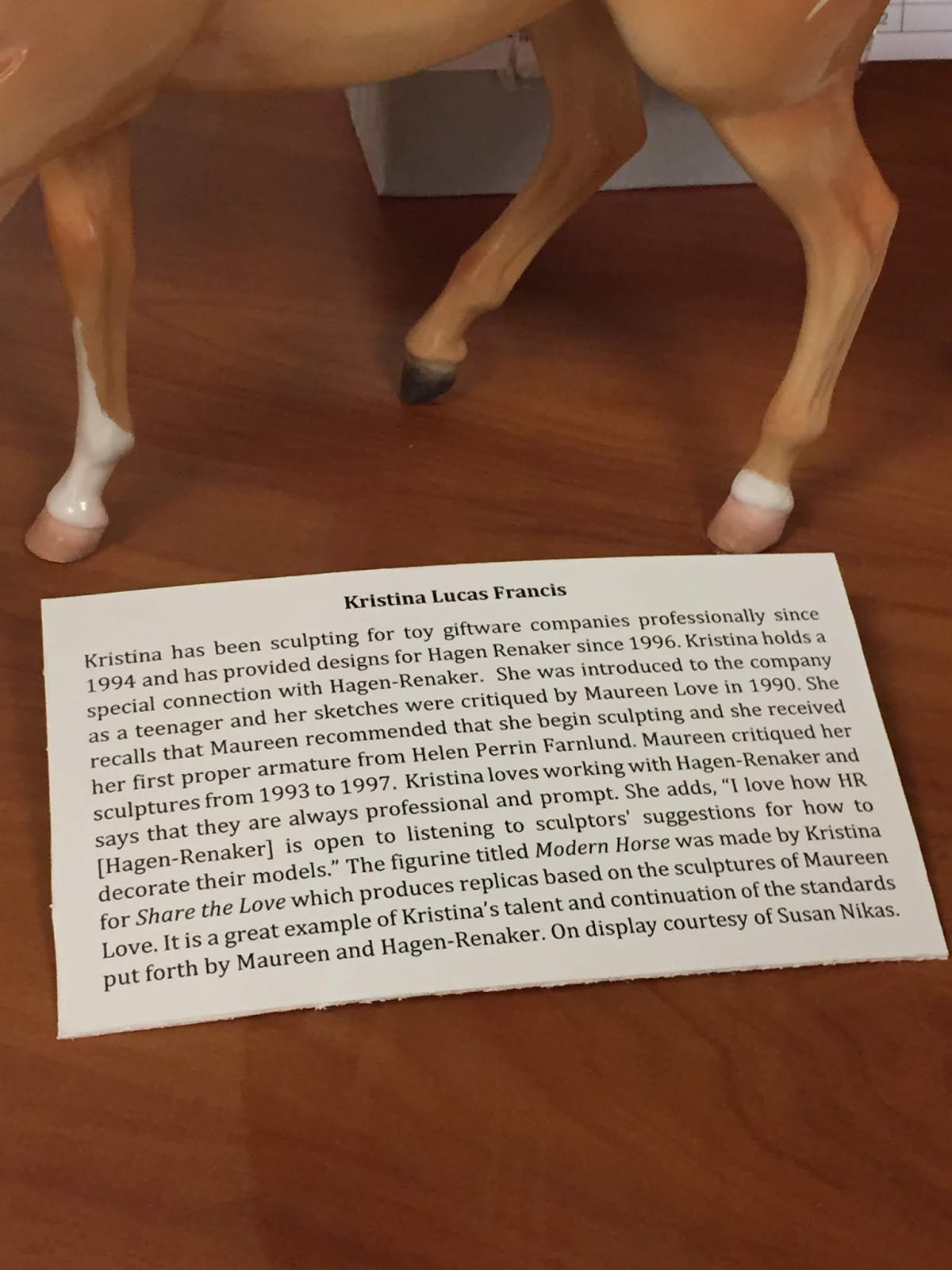

Finally, a long, low display case provided detailed information about the design and production process.

The end of the exhibit showed the Hagen-Renaker production process from start to finish.


While the exhibit was up, many model horse collectors were able to see it. Two large groups of collectors in Southern California for Clinky Mayhem 2018 were among the first visitors. We started out across campus at the W. K. Kellogg Arabian Horse Center....

And met some of the current Kellogg Arabians.


The Library staff displayed some of their archival materials for the collector groups, including this photo and other material on the real Kellogg Arabian Nataf, who inspired Maureen Love's enormous ceramic design.

A gala grand opening for the exhibit was held on May 11, 2018. Dozens of people from the local community attended, along with model horse collectors Claudia Segger, Melanie Teller, Dawn Sinkovich of Share the Love, Lisa Dare, Heather and Michael Wells, and myself. Sue Nikas performed some of her original music with guitarist Les Johnson. The event was profiled in a Cal Poly Pomona University publication.


I presented a paper on the connection between Maureen Love, Hagen-Renaker, and the Kellogg Arabians at the 2018 Equine History Conference. I used the Hagen-Renaker large "Amir" Arabian stallion, and Maureen's original sketch of Abu Farwa that I own, as props during the presentation. I also wrote an article on this subject, mentioning the exhibit, for Arabian Horse Life magazine.

Cal Poly Pomona students were given tours of the Hagen-Renaker exhibit by WKKAHL staff, and many younger students visiting the CPP campus to learn about going to college, also saw the H-R exhibit.
The W. K. Kellogg Arabian Horse Library used materials from the Hagen-Renaker exhibit in its social media. A picture of the H-R miniature "Seabiscuit" by Maureen Love was used to celebrate the birthday of the plucky Thoroughbred race horse who raced at Santa Anita. A photo of a Hagen-Renaker "Abu-Farwa" helped the Library celebrate the National Day of the Horse. A group shot of the four Hagen-Renaker Persian cats, huge to tiny, was used to celebrate National Cat Day.
And this montage of images helped the Library celebrate the birthday of author Marguerite Henry.

There were some unique aspects to the "Miniature Menageries" exhibit. Dozens of model horse collectors were in Southern California right at the start of the exhibit, attending an unrelated event -- Clinky Mayhem 2018, which featured the sale of ceramic and other breakable model horses from the estate of Karen Grimm. With the generous assistance of Clinky Mayhem organizers Heather Wells and Joanie Berkwitz, we were able to organize group tours of the Hagen-Renaker exhibit.
And for two straight years, dozens of equine historians visiting Cal Poly Pomona for the Equine History Conference (put on by the Equine History Collective and hosted by WKKAHL) were able to see the exhibit as well.
Another unique aspect of "Miniature Menageries" was the over-the-top generosity shown by Sue Nikas of Hagen-Renaker. How many academic institutions not only have a large number of valuable historic objects -- some of them one-of-a-kind -- loaned for an exhibit on local history by a local family business, but also have the head of that local business personally provide the entertainment for the grand opening and make an in-kind donation of figurines to support the Horse Library?

It seems to me that the exhibit was perfectly in line with what the University Library Special Collections Unit and the Horse Library do every day: educating and informing scholars, students, horse enthusiasts, and the general public about the rich history of the area the University serves.
The exhibit underscored for me the connection between Hagen-Renaker horse figurines and much broader aspects of history. The model horses Maureen Love designed reflect a period of time in America when the horse was still an important part of the life of a community. In mid-century America, the lives of horses and their owners were inextricably intertwined with private and public life. Horses, corrals, pastures, riding trails, and horse show venues took up space, so the horse was connected to private and public land use and planning. Improvements in transportation allowed horses and their owners to venture outside their own areas to attend larger equestrian events.
Businesses like tack shops, feed stores, hardware and tractor dealers, lumber yards, riding stables, and clothing retailers made part of their living from horses and their owners. Local civic leaders took part in mounted law enforcement patrols and coordinated community activities featuring horses.
 |
| Lippitt Morman's owner, Merle Little, was deeply involved in the lives of the Southern California towns of Monrovia and Duarte. "Lippitt" (as the Little family called him) was the inspiration for the Hagen-Renaker "Lippet" Morgan stallion. |
Local families attended and/or participated in horse shows most weekends of the year. Local communities planned and held parades that featured horses of many breeds, as well as ponies, mules, and donkeys ridden by local adults and children as well as local elected officials and entertainment celebrities.
 |
| A Hagen-Renaker "King Cortez" designed by Maureen Love was part of the "Miniature Menageries" exhibit. |
 |
| The real "King Cortez" was owned by local equestrian Ernest Specht, who rode him in countless Southern California parades, including the famous Tournament of Roses parade, over many years. |
And as Southern California's population continued to grow after World War II, freeways, car dealerships, housing, schools, and shopping malls ate up the valuable land where horses used to graze. Keeping a horse became more and more expensive.
Hagen-Renaker itself employed hundreds of local workers over the years, many of whom were women, in an era when many businesses still did not offer opportunities for women to express themselves creatively or take leadership roles. The employees and management involved themselves in their local community, taking part in civic events and recreation.
And we can't overlook the importance of the Kellogg Ranch property as a major hub of equestrian activity. W. K. Kellogg never could have predicted that some of the horses foaled on his property would end up being reproduced in ceramic first and later in plastic, and that millions of them would stand on the shelves of the collectors young and old who love them. I like to think that his horse-loving businessman's heart would have approved of the "Miniature Menageries" exhibit and all it represented.
(Disclaimer: I am not affiliated with WKKAHL or Cal Poly Pomona. These are just my observations about the exhibit and its importance.)
Links:
W. K. Kellogg Arabian Horse Library:
https://www.cpp.edu/library/wkkahl/
Hagen-Renaker, Inc.:
Nancy Kelly's books about Hagen-Renaker:
Hagen-Renaker Tennessee page on Facebook:
Hagen-Renaker Collectors Club (annual subscription):


