Wednesday, April 19, 2023

The Many Model Horse Photos of Hobbyist Ellen Hitchins

Two of Ellen Hitchins' Breyer Old Mold Proud Arabian Mares,
India and Sincerity.

Ellen Hitchins (1951-1996) was one of the "founding mothers" of the model horse hobby. She called her model horse stables "B&B Tack & Stables."

Ellen attended Cal Poly Pomona and pursued a career working with horses. Author Nancy Kelly, whose book Exploring the Model Horse Hobby is such a treasure, shared with me this photo of Ellen taken at the W. K. Kellogg Arabian Horse Center at Cal Poly.

Nancy's book, and the many Facebook groups on vintage model horses and their history, are great sources of information about how the organized model horse hobby started in the late 1960s.

Ellen's friend (and mine) Laurie Jo Jensen loaned me a small box full of some of Ellen's model horse show photos from the 1960s and 1970s. Looking at them is truly a trip down memory lane. 

By looking at the horses in Ellen's collection, we can:

-- Observe the state of the early organized model horse hobby from the perspective of someone who took it seriously

-- See names of some of the other early hobbyists

-- Imagine the impact of seeing ceramic Hagen-Renaker and Beswick horses in show photos for the first time, if you'd only known about Breyer and Hartland horses before

-- See examples of early flocked repainted model horses

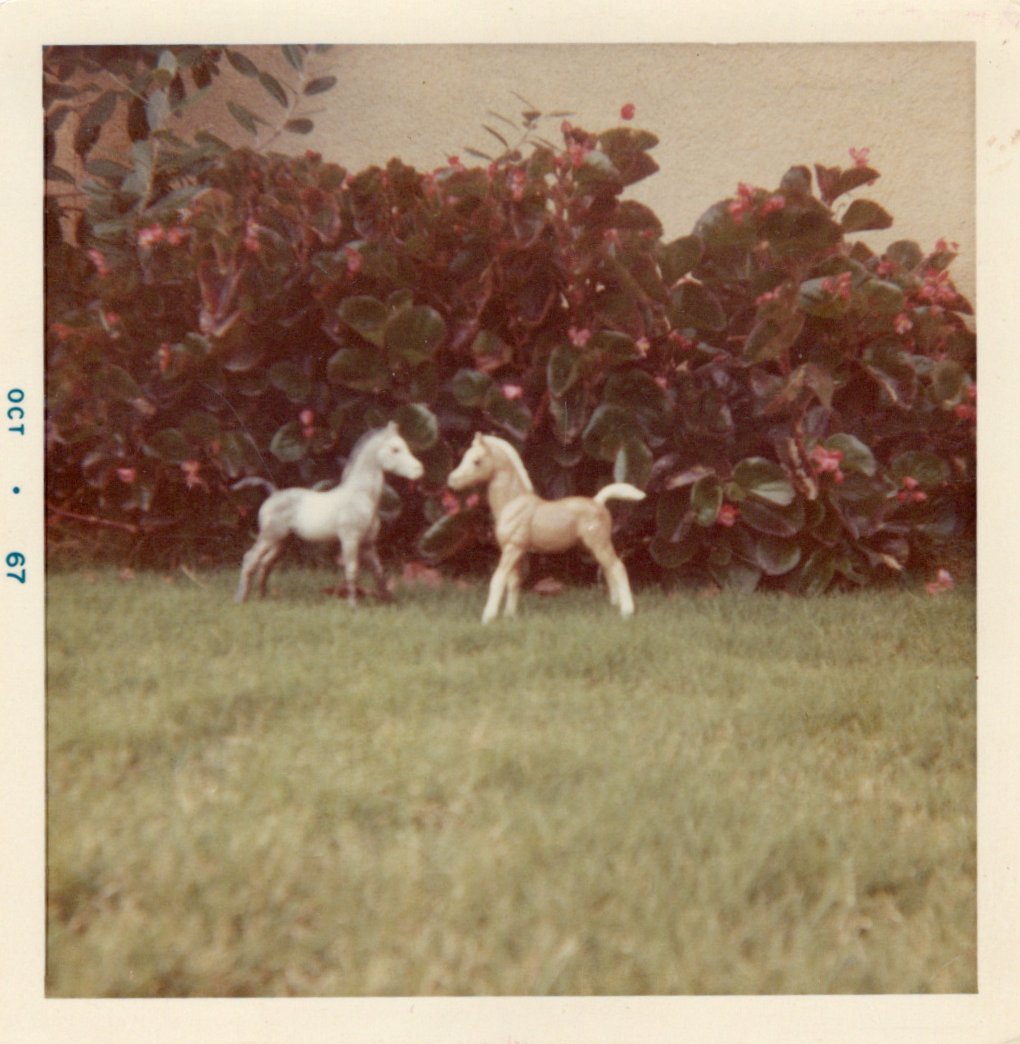
-- See how model horse show photography changed and improved, once a hobbyist started using a 35mm camera. Below we see Ellen's Breyer Family Arabian Foals Seven Eleven (left)and Chewy (right), in October 1967. This print looks like it could have been taken with a point-and-shoot Kodak Brownie or similar camera.

This is Ellen's Old Mold Proud Arabian Mare Seraphim, March 1970. She was probably photographed with a 35mm single-lens reflex camera.


I don't have time or space to show all the photos from Ellen's estate, but these will provide an overview of the diversity of her collection. 

So, in no particular order of importance, here are some of the highlights from Ellen Hitchins' photo show string.


VIRGINIA ORISON HORSES

Ellen owned horses we all would have coveted. This is an Arabian stallion hand-crafted by Virginia Orison. Most young model horse collectors couldn't afford these, but we sighed over the photos in Orison's ads in Western Horseman and other magazines in the 1960s-70s. Ellen called him Alla Habu.

 
The photo below, of a Thoroughbred called Warlock, has the name and address of Lourie Ellen Reid of New Jersey hand-written on the back. He's also a Virginia Orison creation, currently owned by Laurie Jo Jensen.


On the back of this photo is written "Domino, QH Stallion, Dark brown, black points." I believe he too is a Virginia Orison creation, although it's possible the negative was reversed when the print was made.


SHIRMAR
Three of Ellen's photos appear to be of Shirmar copies of the large Hagen-Renaker Arabian family: Zara, Amir, and Zilla. It's rare to see photos of them as unfinished pieces. 


Shirmar Ceramics was located in Pomona, California, where Ellen attended college. I see classified ads for them in the archives of the Pomona Progress-Bulletin newspaper from 1969 to 1974. Many contemporary hobby experts believe these were not authorized copies, but I wanted to show them for hobby history's sake. Shirmars still show up occasionally in collections and at model horse events.


ORIGINALS BY COWIE
Some of Ellen's photos are of model horse designs I'd never heard of.


Ellen called this Palomino Quarter Horse mare Margarita De Oro, and the back of her photo is marked "Original by Cowie." "Cowie" was Linda Cowie of Missouri.

This is another "Original by Cowie" -- an Arabian stallion Ellen called Sultaniman Abduraqueman, or "Abdu" for short. 


Another Cowie creation was Allah Serneyn. He looks magnificent in this photo. 


HAGEN-RENAKERS
Imagine what it would have been like, if you'd been a youth in the early 1970s, and you'd never even heard of Hagen-Renaker horses...and you saw this photo of Ellen's Hagen-Renaker "Sheba," Serabi.


Ellen also showed other Hagen-Renaker horses. This is her "Roan Lady" Tennessee Walking Horse mare Stately Again, elegant in black and white. 


And this Hagen-Renaker small "Honora"  is Stately Brantley Boy, an American Saddlebred stallion.


Ellen photo-showed this Hagen-Renaker "Kelso" as Peg O' My Heart, a Quarter Horse mare. She wasn't the only model horse hobbyist who thought the Kelso mold made a good mare.


To save money on film processing, and if the photo show holder allowed it, collectors would sometimes photograph two models at a time. These are the Hagen-Renaker Morgan foals "Roughneck" and "Scamper," shown as Assam and Antigone, Arabian foals.

This Hagen-Renaker small "Zilla" foal was Touch of Amber, shown as a colt.

This mini Hagen-Renaker head-up Appaloosa could compete against larger horses in the early 1970s, although without a good closeup lens it was challenging to get a good picture of him. At this point, Ellen did have a pretty good camera.


MODEL HORSE RECORD-KEEPING
Ellen kept track of some of the shows her horses entered. This pre-printed cardstock record shows the name of the show, the "executive" (show holder), and the date. The people holding the shows included Simone Smiljanic, Karen Pate, Marney Walerius, Ginny Venator, Kathy Maestas, and others. 


VINTAGE CUSTOM HAGEN-RENAKERS
Given the dates of the photos, which are all 1973 or earlier, I believe this is a vintage custom Hagen-Renaker "Man O' War," rather than the 1975 Breyer plastic version. The name on the back of his photo is Diamond Jubilee. 


This appears to be the same horse, minus the "hair" mane and tail. I wonder which came first, and whether he was an early one of the famous "Diamond" horses of Kathy Maestas?


This Hagen-Renaker small "Zilla" foal was repainted chestnut. Ellen showed her as Mi Nefous.


REVELL KIT HORSE
Another Appaloosa in Ellen's show string was Cayenne Cochise, a Revell Appaloosa "kit" horse. (Other hobbyists have told me that the Revell Appaloosa came in brown and black.) Ellen kept 3x5" index cards showing his show record in performance and halter classes for 1968. Now THAT is early organized model horse hobby history.


This is one of his actual show photos.


UNKNOWN MAKERS
It was not uncommon for photo A shower to have a very diverse show string. I don't have any information on the maker(s) of these next four vintage model horses. The Appaloosa and the buckskin may have been made by a company called Hampshire Hill or Hills.  If any of my readers have additional information, please share it in the comments below!


This next one has the name and address of hobbyist Jo Maness in Texas written on the back. No information about the horse or its maker, though.

No information on the maker of this horse.

I have no information on the maker or identity of this cheeky pony. But look at that face. 

BESWICKS
In Ellen's day, a Beswick (England) horse could compete well against horses by other makers. They could be difficult to find, unless you had a source near the Canadian border or a high-end gift store in your area. Ellen had several very nice examples in her photo show string.

Ellen didn't write the name of this Beswick "Therese of Leam" Connemara Mare on the back of the photo.

This Beswick "Coed Coch Madog" Welsh Pony is also unnamed. 


This is *Skye Cameron, a matte brown Beswick Quarter Horse.


Minderbender, a Beswick matte brown "Bois Roussel."


FLOCKED MODEL HORSES

Back in the day, it was not uncommon for hobbyists to customize their own models with flocking. Ellen had several flocked model horses in her herd. This flocked Breyer Proud Arabian Mare was called Serante.


This flocked Breyer Western Prancer was shown as Allah Rakida.  Note the date on the side of the photo print, July 1970.


This Breyer stretched Morgan was shown as Allah Raseyn, an Arabian stallion. 


Here's a smaller flockie, this time a foal made overseas. He is either ceramic "Made in Japan" or plastic underneath the flocking. If I recall correctly, this mold was about the size of a Breyer "Classic" foal.


CUSTOMIZED MODEL HORSES WITH BIG HAIR
Several of Ellen's photos show vintage custom model horses with what appear to be thick yarn manes and tails. Their photos are dated 1973. There's no information about their names or creator(s) on the backs of the pictures.


HARTLAND HORSES

This Hartland 11-inch Quarter Horse is was customized as a pinto, shown under English tack 


This Hartland Arabian foal was named Antares and shown as a "Colombian Paso Foal." The name and address of Linda Mayfield of Los Angeles are hand-written on the back.


ORIGINAL FINISH BREYER HORSES

Ellen had an awesome collection of Breyer Proud Arabian Mares. Most of them were original finish "Old Mold" mares, made between 1956 and 1959. 


I have no information on them except Ellen's writing on the back of this group shot:

India
Sincerity
*Nafa
Surfilind
Seraphim
Royalindy
Wine Tumbler
(not shown: White Dove, *Serante')

There's no date on the photo. I'm assuming Surfilind was repainted (customized); there were no other photos of her. 


India had an Old Mold Proud Arabian foal called Silver Faranah. They are shown in this photo.


Wine Tumbler is the rare Appaloosa Old Mold PAM, shown here under Western tack with India.


Online hobby sources, including the Identify Your Breyer website, say there are only two known factory test Palomino Proud Arabian Mares that date to 1971. Ellen owned one of  them, and called her Spring Miraj. Three of her show photos date to June 1971.


The June 1971 date on the photos adds to this mare's backstory. I checked with Breyer expert Kirsten Wellman, who currently owns her. Kirsten wrote on her website:

The palomino PAM was long thought to be a hobby myth, and this gal is very probably the model at the root of the stories. She is a test run that dates from around 1970 or 1971. At that time, Breyer had re-acquired the rights to produce the PAM, and as a "new mold" model with a stamp, this mare is thought to have been a test run for the new mold PAMs. They were ultimately released in mahogany, alabaster, and dapple grey, but not palomino.

In 1971, renowned hobbyist, collector, and Breyer consultant Marney Walerius brought this model home from the factory, and it has been in collectors' hands ever since. I am guessing that Breyer opted not to produce the Proud Arabs in palomino because the Family Arabs were already available in that color and had been for some time.


Now we know that another of the collectors who owned her, at some point, was Ellen Hitchins. 

The grass in this photo appears different than in the photo dated June 1971 in the border. I wonder if it was taken before, or after, June 1971?


Wood Moss was a Breyer Woodgrain Stretched Morgan stallion with a variety of halter and performance show photos.


METAL QUARTER HORSE 
This Quarter Horse stallion was called Wise Decision. I'm not sure of the maker, but he appears to be a metal trophy top.


Film and processing were relatively expensive, on a young person's budget, and color film and processing even more so. I remember entering photo shows in the mid-1970s that had a mix of entries in black and white and color. 

Some of Ellen's black and white photos are just small works of art.


I'm hoping that once I share this post, other older hobbyists will respond and give me more information, or clarify the information, on the horses shown here. That's one of the many ways we learn more about the genesis of the organized model horse hobby, from the late 1960s to early 1970s.


Wednesday, March 29, 2023

More on Model Horse Artist Virginia Orison, from Western Horseman magazine


Artist Virginia Orison, in the August 1964 issue of Western Horseman

A friend gave me some vintage back issues of Western Horseman magazine last weekend. I was pleased to see a feature article on artist Virginia Orison. I'll share it here, to complement the other posts I've written about her.


Here are my previous blog posts that discuss Virginia Orison's art. The one gives an overview:

https://modelhorsehistory.blogspot.com/2019/02/ahead-of-her-time-equine-artist.html


Two examples of Orison's art that I found at an estate sale are shown at the end of  this post:

https://modelhorsehistory.blogspot.com/2019/10/illuminating-model-horse-hobby-history.html


Here are some more pictures of Orison's horse show awards:

https://modelhorsehistory.blogspot.com/2019/10/more-on-sculptor-virginia-orison-horse.html

Sunday, March 19, 2023

The Handcrafted Horses of Oregon's Fannie Branson (1881-1965)


The more I learn about the history of model horse figurines, the more I am amazed at the skill of the artists who create them, particularly handmade horse figurines. The horse figurines I'll share in this post predate the organized nationwide model horse hobby by several years.

Which of us has not visited the International Museum of the Horse and the Saddlebred Museum in Lexington, Kentucky (perhaps during BreyerFest), only to come away wishing we owned a handmade horse by Calvin Roy Kinstler or Francis Eustis like the ones on display?

Saddlebred by Calvin Roy Kinstler,
at the American Saddlebred Museum, Lexington, KY

Some of the Horses of the World, by Francis Eustis,
at the International Museum of the Horse, Lexington, KY

And many current collectors recall wishing they could afford a handmade horse by Idaho artist Virginia Orison, who advertised her work in Western Horseman and other horse magazines.  

Back in their day, works by artists like Orison, Kinstler, and Eustis were not often found in a child's collection; rather, they were considered art or craft objects collected by adults, to be displayed in the home library, den, or mantlepiece. 

Arabian by Virginia Orison.
Author's personal collection.

Predating Orison was another female equine artist, Fannie (Lamberson) Branson (1881-1965) of Oregon, whose covered balsa wood horse creations drew a great deal of public attention between the 1930s and 1960s.


Bend, Oregon Bulletin, 18 October 1952.

Branson's work is not often found "in the wild," but occasionally we do hear of examples. Horsewoman Nancy Ecklund contacted me asking for information on Fannie Branson, because she owns an amazing model horse with handmade tack by Branson. She gave me permission to show her photos of the horse in this blog post. 

Buckskin horse by Fannie Branson. Balsa wood, probably with calfskin covering
and angora goat hair mane and tail.

It even has a dorsal stripe!

Branson marked her creations with tiny metal plaques on their undersides.

Other examples of Branson's horses are in the collection of the Lincoln County, Oregon Historical Society Museum. The Lincoln City News-Guard published a story in 2016, with this photo.


The Nelson Museum of the West in Cheyenne, Wyoming also owns two examples of her work.

Source: The Nelson Museum of the West's
public Facebook page.

The Lincoln County Museum shared this good summary of Branson's life and horses, with photos, on its public Facebook page.

Source: the public Facebook page of the Lincoln
County Historical Society, Newport, Oregon

Fannie (Lamberson) Branson was born in Cow Valley, Oregon in 1881. She was raised on a ranch in Malheur County where she learned horsemanship riding herd and honed her whittling skills. Branson shattered her hip at an early age when her horse tumbled on top of her and suffered from chronic pain and reduced mobility for the rest of her life.

This accident didn’t slow her down. Fannie married Jay Branson in 1903 and by 1935 they were operating the nation’s first Roquefort cheese factory in Scio, Oregon. They later moved to Agate Beach where Branson started a business selling intricate miniature horses she carved by hand. They eventually opened a museum where Branson displayed her work, which in 1951 alone had over 6,000 visitors.
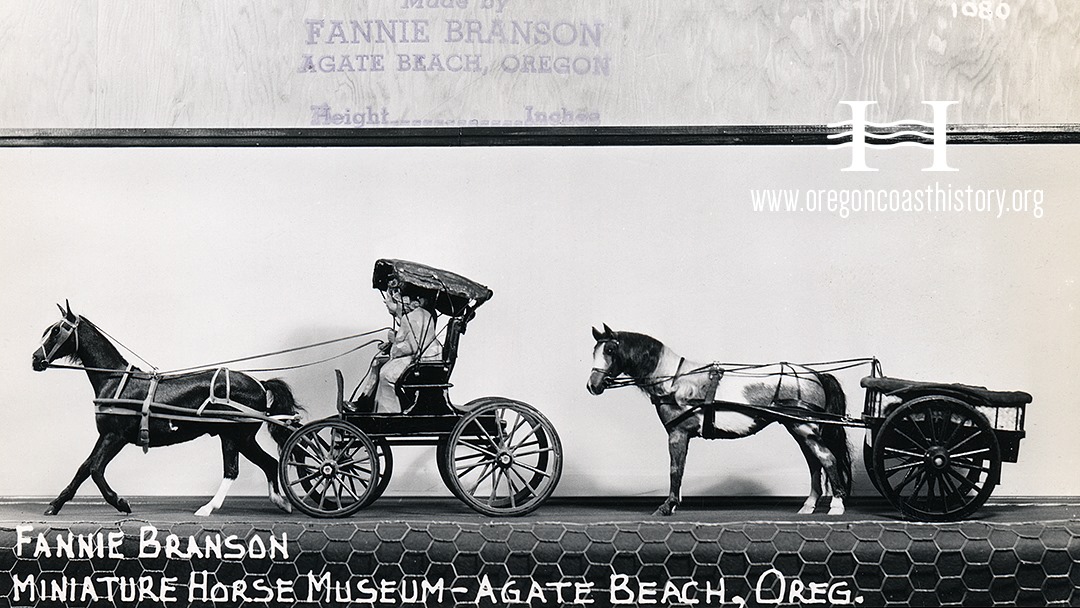
Source: the public Facebook page of the Lincoln
County Historical Society, Newport, Oregon 

Branson’s horses sold well, and they appeared in collections around the world. As Branson once told a local reporter, “…something that kept me from feeling sorry for myself for being crippled became a full-time business…”

When her health began to fail in 1964, Fannie arrived at the hospital with a small suitcase of model horse parts to work on. Today her 600-800 masterpieces are scattered across the globe, and we are happy to have her work in our collection.


Source: the public Facebook page of the Lincoln
County Historical Society, Newport, Oregon 
I read through a number of newspaper articles that were published during Branson's active years as an artist. They all say the bodies of the horses were made of balsa wood, but the other materials she used varied over time.  

In 1939, when Branson was living in Scio, Oregon, an article in the Salem Statesman-Journal gave this description of the horses themselves. Over the course of her career, Branson had changed the materials she used to make her horse figurines:


Branson also made the tack for the models.


Branson's model horses were very popular with local buyers.


In 1940, the Albany, Oregon Democrat-Herald reported on the Lebanon Garden Club's annual show, which expanded its horizons to include the work of local artists. The article described Branson's use of natural materials.


In 1945, the Rock Island, Illinois Argus ran an article on another artist who was inspired by Branson's work. Heloise Hopson of Agate Beach, Oregon, had given up her job in a retail store to make covered wagons in Branson's studio.


In 1946, the Spokane, Washington Spokesman-Review ran a short feature on Branson's work with photos of a variety of equine subjects, including a mule.


In March 1952, the Eugene, Oregon Guard newspaper published a feature story on Branson with more pictures.


As the  Lincoln County Historical Society website said, Branson and her husband set up a museum to display her work in Agate Beach, Oregon. Postcards and matchbooks helped promote it.

Front of postcard from Fannie Branson's miniature horse business,
showing a Pinto with Western tack. (Source: eBay)


Source: eBay. This matchbook sold for less than $4.00.

Despite its initial success, the museum folded, and in 1954 newspapers reported that the building was remodeled to accommodate three local businesses. But she kept creating her unique horse figurines.

When Branson passed away in 1965, the Salem, Oregon Capital Journal ran an obituary that summarized her life and work.


_________________________________________________________

Many thanks to Nancy Ecklund for allowing me to use the photos of her Fannie Branson horse. Thanks also to Tina Dils, one of the hardest-working and kindest people in the model horse hobby, for connecting us.


The January 1946 edition of Popular Mechanics ran an article with photos on Fanny Branson. You can access it here:

https://books.google.com/books?id=MuEDAAAAMBAJ&pg=RA1-PA49&lpg=RA1-PA49&dq=%22fannie+branson%22+horse&source=bl&ots=OSZNCgtfM7&sig=ACfU3U1qZ5cw0UzNlUSX0JYuaf_XuHCi-A&hl=en&sa=X&ved=2ahUKEwifwLHhhun9AhXsHEQIHSE-CuwQ6AF6BAgmEAM#v=onepage&q=%22fannie%20branson%22%20horse&f=false

The Lincoln County Historical Society website is here: https://oregoncoasthistory.org/

The Nelson Museum of the West's website is here:

http://www.nelsonmuseum.com/