Monday, March 14, 2022

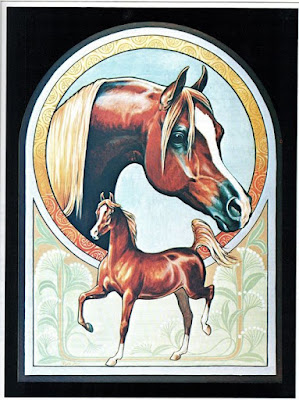
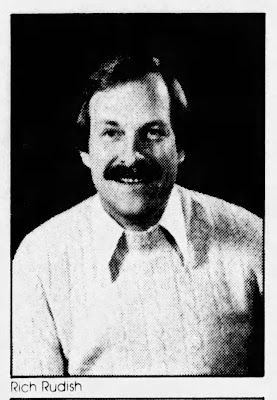
Sharing from The California Horse History Project: Original Painting by Rich Rudish

Model horse collectors are familiar with Rich Rudish as the designer of the Breyer horses "Sham" and "Lady Roxana" as well as several horses produced by Enesco. I recently found an early example of Rudish's "flat" art at an antique mall, and wrote about it in my blog California Horse History Project.

https://californiahorsehistory.blogspot.com/2022/03/chestnut-arabian-by-artist-rich-rudish.html

Sunday, March 13, 2022

Chestnut Arabian by artist Rich Rudish

Every so often a piece of a horse's story will find its way to me, demanding to be told, reminding us of just how important the horse was to the humans who loved him. That happened to me again today, when my Horse Radar went off as I drove towards an antique mall.

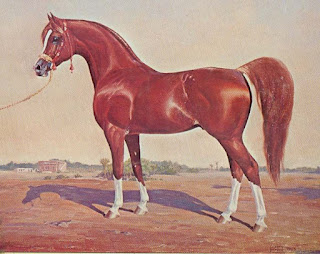
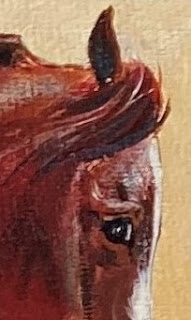
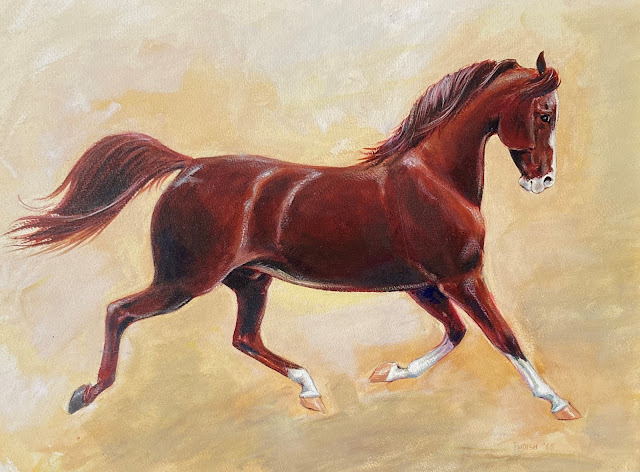
When I went inside, I quickly spotted a very special original painting. The first thing I noticed about it was the horse's unmistakable brilliant chestnut color with white markings. He looked like an Arabian.


The second thing I noticed was the artist's signature:
 "RUDISH '65."  

The artist was Rich Rudish. Sold.

But I wondered: Was this a portrait of a real horse? And if so, how could I find out? There were no other identifying marks on the painting, front or back, so I looked for clues from other sources.
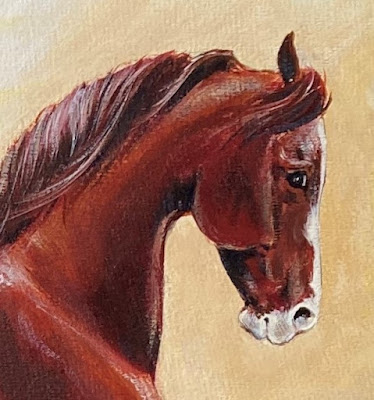

Rudish was born in 1941; the painting is dated 1965. So he was only 24 when he painted it.  A Kansas City newspaper article said that Rudish joined Hallmark Cards as an illustrator in 1964, so we know he was active as an artist as a young adult.

With those dates in mind, I started looking for connections between Rudish and Arabian horses. Newspaper articles told me that Rudish rode and trained Arabians in the Midwest in the 1960s. 

After a few minutes' searching online I came up with the name of a horse ridden in a show by Rudish: the chestnut Arabian gelding Zartai, foaled in 1954.
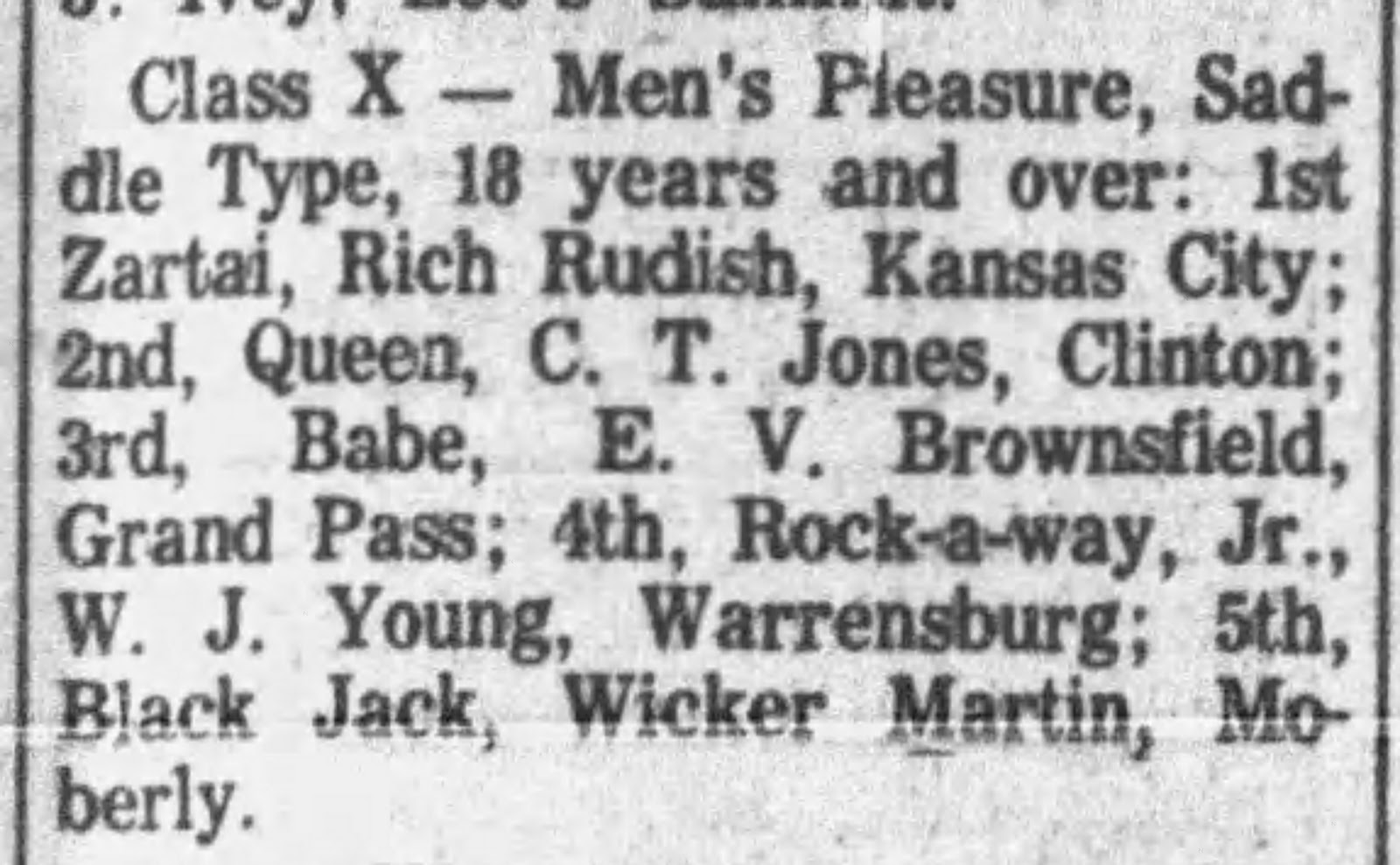
The Clinton, Missouri Eye newspaper,
July 19, 1966.

I kept looking, and found a photo of Zartai from 1967, ridden by none other than Rich Rudish. Zartai had won a Top Ten Award at the Arabian US Nationals.
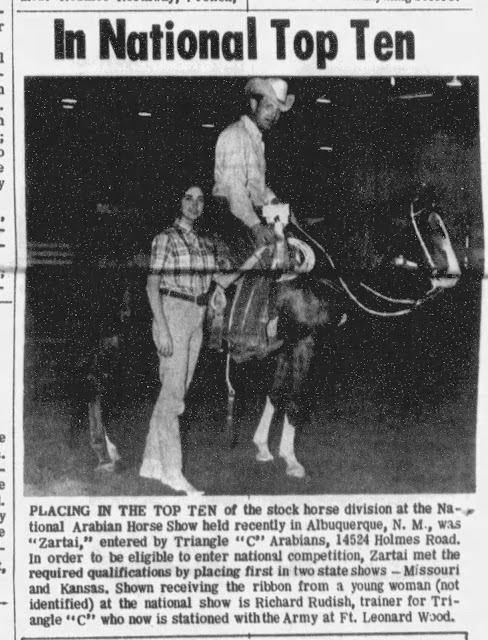
Belton, Missouri Star-Herald, August 24, 1967

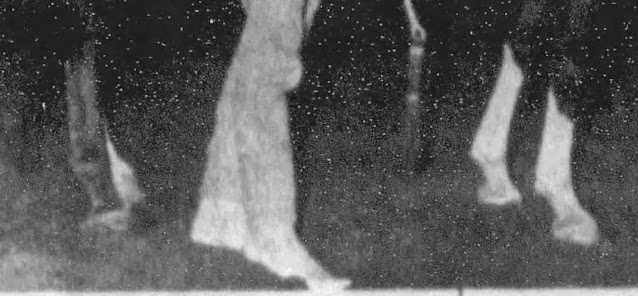
The picture is not great quality, but we can see that Zartai had an oddly shaped blaze on his face...

So does the horse in the painting.
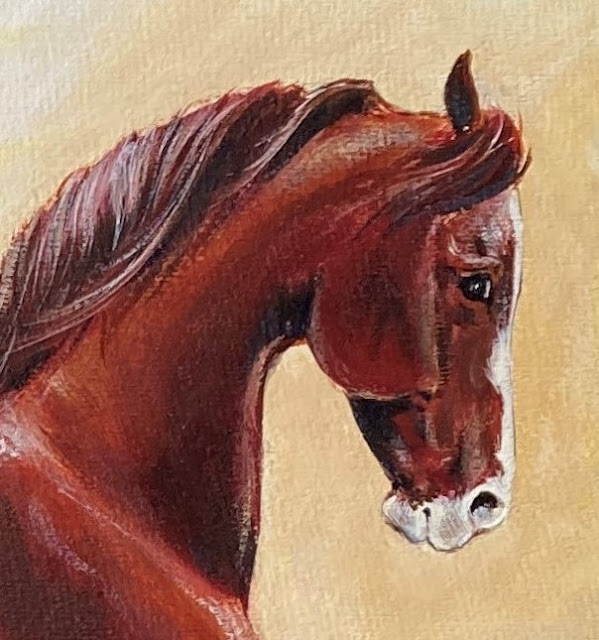

Zartai had two white stockings on his forelegs, and a white sock on his left rear leg...

So does the horse in the painting!

So I think it's highly probable that the horse in the painting is indeed Zartai.  A search of the Arabian Horse DataSource shows that Zartai, foaled in 1954, was sired by Ibn Nusi; his dam was Zatai.
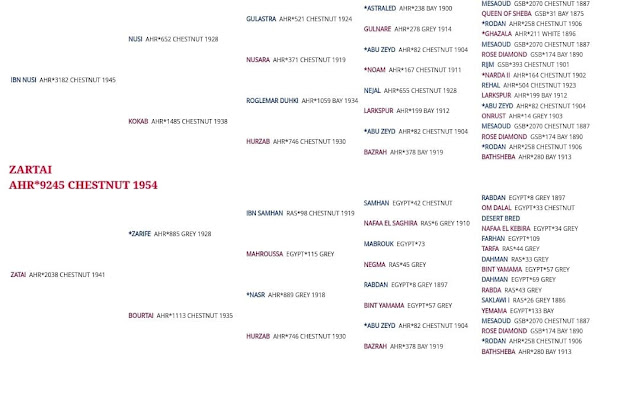


Zartai's pedigree reads like a Who's Who of Arabian horses in the late nineteenth and early to mid twentieth centuries; many of his ancestors were owned by the likes of the Crabbet Arabian Stud, Homer Davenport, W. R. Brown, Spencer Borden, and J. M. Dickinson. As a Top Ten stock horse at the US Nationals, Zartai did his ancestors proud.

It's difficult to single out a few of the important Arabian horses on Zartai's family tree, but here are some. It's interesting that some of these horses were the subjects of other artists' work.

Zartai's great-grandsire Gulastra, a chestnut stallion, was bred by W. R. Brown, and later owned by William Randolph Hearst, J. M. Dickinson, and Bazy Tankersly of Al-Marah Arabians.


And this is Gulastra's portrait by artist Elizabeth Bell. You used to be able to buy prints of her work through the mail; this one was signed.


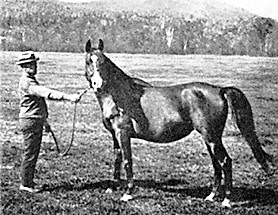
Zartai's great-great-great-grandsire Mesaoud -- also chestnut -- was purchased in 1889 by Lady Anne Blunt and her husband Wilfrid. He had an enormous influence on the Arabian horse.


Mesaoud was immortalized in this portrait by Gladys Brown Edwards:


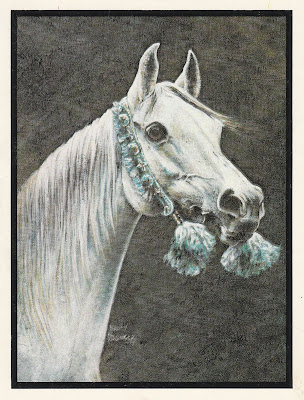
Another of Zartai's ancestors was the great and beautiful mare Mahroussa.  Here's a head study photo by Carl Raswan:


A print of a painting of Mahroussa by C. W. Anderson:


And another by Arizona artist Nancy Strowger, reproduced on a greeting card:


Another female ancestor of Zartai was the influential mare Bazrah, who lived out her days in California. W. R. Brown sold her to William Randolph Hearst; she later went to Roy L. Jackson of Orange, California, and died in 1948. (I couldn't find a painting of her, so equine artists, here's your chance.)


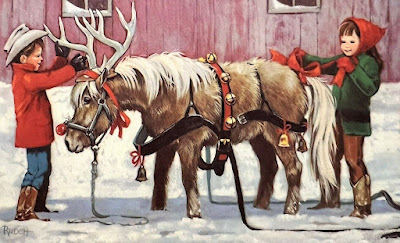
Rich Rudish had a varied career. He worked for many years at Hallmark Cards, creating several popular animal characters. My favorite of his greeting card images is a Christmas card with Arabian horses. 

Here are two more examples of Rudish's greeting card designs with horses:
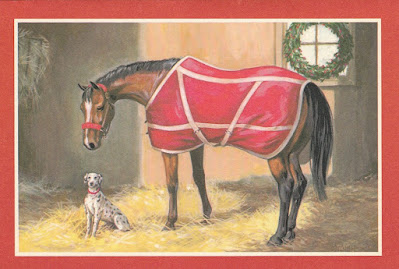
A Hallmark card


An Ambassador card


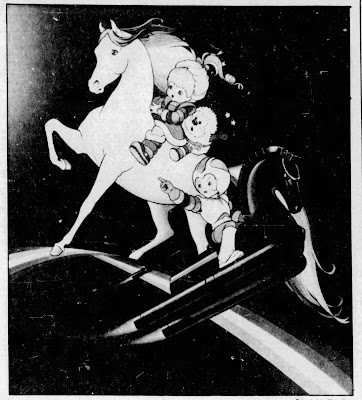
Rudish served as Director, Art Director, and in the Animation Department on several films in the 1980s, including many of the "Rainbow Brite" animated movies.


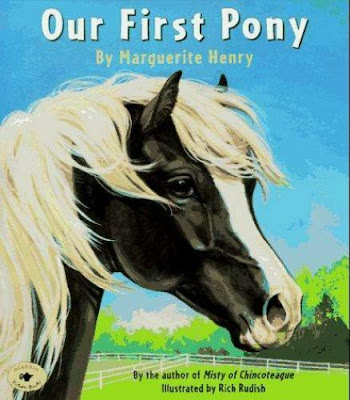
Among horse lovers, he is well known as an illustrator of horse books such as Marguerite Henry's Our First Pony, and the 1975 edition of her book The Little Fellow.


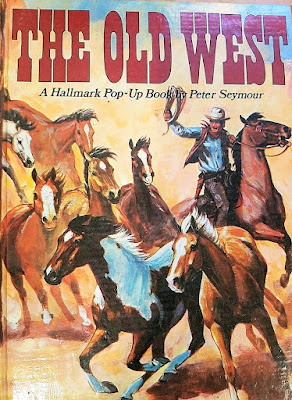
Rudish's art appeared on coffee mugs and playing cards. He also illustrated a pop-up book called Dancer and a calendar for Hallmark, as well as a book on the Old West.


Rudish illustrated Arnold R. Rojas'  book These Were the Vaqueros.

He also designed model horses for Breyer, including "Sham" and "Lady Roxana," and also for Enesco.
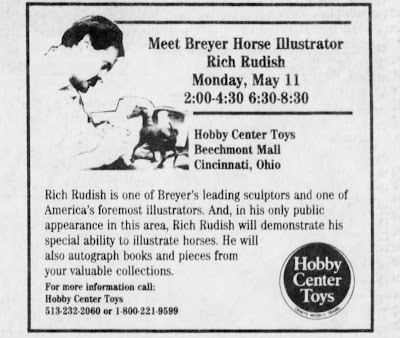
Cincinnati Enquirer, May 10, 1987

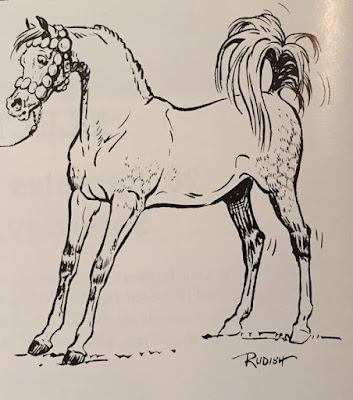
Starting in the 1970s, it was common to see illustrations by Rich Rudish in Arabian horse magazines and horse show programs. You can see his style evolving over the years.


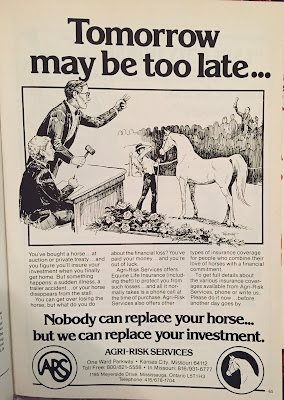
Rudish's sense of humor is obvious
in this illustration in an advertisement.


Rudish's stylized color ads depicting real Arabians are unmistakable.
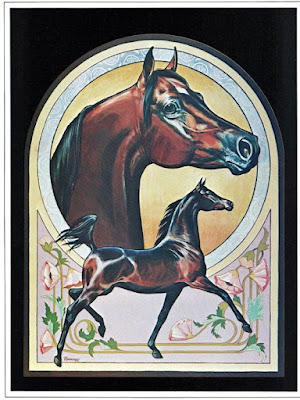
*Tamarlane and Taktika

*Padron and Bint Padron


Rich Rudish died in Los Angeles in 1989, which may partially explain how the painting of Zartai made its way to an antique mall in next-door Ventura County. Where the painting was in the meantime, we may never know. Perhaps Rudish himself saved it, sold it, or gave it to someone else. However this example of Rudish's early art came to me, I like to think that somehow its story needed to be told, if only to remind us again just how important horses, and our memories of them, are to us.


Many thanks to equine history researcher Tobi Lopez Taylor for her assistance in preparing this blog post.

____

Because I'm such a fan of the Kellogg Arabians, I want to mention that Zartai is related to the great chestnut Arabian stallion Abu Farwa, foaled at the Kellogg Ranch, through their mutual great-grandsire Gulastra. Here's Abu Farwa.


And a previously unpublished photo of him, owned by model horse hobbyist Melanie Teller:


Model horse artist Chris Nandell wrote this lovely tribute to her friend Rich Rudish:


Thursday, January 13, 2022

The Hagen-Renaker Horse / Tournament of Roses Parade Connection

Hagen-Renaker "King Cortez" rearing stallion,
from the company's Monrovia era (late 1950s)


I think most people probably enjoy watching (or seeing in person!) the annual Tournament of Roses Parade on New Year's Day because of the flower-covered floats.


But horse lovers watch the parade because of the equestrian units, of course. What model horse collectors might not know is that at least four of the real horses that inspired Maureen Love's equine designs for Hagen-Renaker, Inc., were regular Rose Parade participants, back in their day.

Old horse magazines and newspaper articles show us their images.

The huge palomino American Saddlebreds King Cortez and his sons, Golden Son Cortez and Golden Don Cortez, appeared in many Rose Parades.  


This photo from Western Horseman magazine, January 1962, shows the Cortez boys in their elaborate (and very heavy) silver-mounted tack.


King Cortez was said to have been quite tall, 17.1 or 17.2 hands high.

The silver-mounted tack of the "Cortez Boys," as some model horse collectors call them, was not always that elaborate. Here's an early photo of King Cortez, showing less ornate tack and a shorter mane.


It was not uncommon to see dozens of Palomino horses in the Tournament of Roses Parade during the 1950s and early 1960s.  I bought this slide of King Cortez on eBay not long ago. I'm pleased to be able to share it here, since the image came from a private collection and the seller had no idea who the horse and rider were.  In other words, we hadn't known this photo of him existed before now. 

But I recognized King Cortez and Ernest Specht immediately. The "Cortez" horses may have been recognizable by their long manes and tails and those extraordinary silver saddles, but there was one other way to tell if you were looking at King Cortez. 


Do you see it?  


He's wearing his silver name tag, which is mentioned in a paragraph about him in a book about Palomino horses from the post-World War II era. 

The Hagen-Renaker ceramic figurines King Cortez:

Photo courtesy of the online Hagen-Renaker Museum (link below).

Sun Cortez:

Photo courtesy of the online Hagen-Renaker Museum (link below).


and Don Cortez:

Photo courtesy of the online Hagen-Renaker Museum (link below).

...were first issued in Fall 1957, as Mustangs.

The chestnut Morgan stallion Lippitt Morman appeared in the Tournament of Roses parade as well. Lippitt's owner, Merle Little, and his family were regular Rose Parade participants, from the early 1930s through the 1940s. (Before he bought Lippitt Morman in 1948, newspaper accounts show us that the Littles rode black and white pinto horses in the parade.)


A photo in The Morgan Horse magazine from December 1948 shows the whole Little family on their Morgans, as they got ready for the 1949 Tournament of Roses parade.  Lippitt Morman is the horse on the far right.


And here are some examples of the Hagen-Renaker "Lippet" Morgan stallion:

Photo courtesy of the online Hagen-Renaker Museum (link below).

____________

Dawn Sinkovich's blog, Share the Love, provides us with more information on, and photos of, Lippitt Morman and Maureen Love's sketches of him.


http://sharethemaureenlove.blogspot.com/2017/04/

Kristina Lucas Francis' blog, Muddy Hoofprints, gives us more information on the Cortez horses:

http://muddyhoofprints.blogspot.com/2014/07/


You can see examples of more Hagen-Renaker horses here, at Ed Alcorn's amazing Hagen-Renaker Online Museum:

http://hagenrenakermuseum.com/

And if you enjoy collecting Hagen-Renaker figurines of all kinds, membership in the Hagen-Renaker Collectors Club is an affordable way to learn more about the history of the company and its figurines, past and present.

http://www.hagen-renakercollectorsclub.com/


Wednesday, January 5, 2022

Hagen-Renaker History: Duck Duck Gone


Understanding the histories of the companies that make model horses and other animal figurines can give us valuable insight into the times and places they were first produced.  

The other day, I came across a tiny piece of Hagen-Renaker history that I had never seen before. It was in an article in the Monrovia News-Post, dated September 29, 1947.

The weather was nice that week; highs in the low to mid 70s, overnight lows in the low 60s, with a few night and morning low clouds and fog (as are often seen in Los Angeles County).  The Hagen-Renaker company was just getting started, and -- for whatever reason -- Maxine Renaker had set 700 unfinished duck figurines in her front yard. 


The article read:

Clay Ducks Stolen

    Mrs. John Renaker of 1018 S. Myrtle Ave. reported to police yesterday the theft of 700 unfinished clay ducks from the front lawn of her home.  

That was the entire story.

This news begs at least two questions. One: Which Hagen-Renaker ducks? They could have been the Model No. A-8 and A-9 miniature ducks. We know from the company's hand-written Mold Book that a Baby Duck (about 1 1/4" tall) and a Mama Duck (about 2" tall) were among the first little animals produced by Hagen-Renaker. These were only issued in 1948-1949. 


Detail from the Hagen-Renaker Mold Book
showing the Duck Baby and Duck Mama.

Two A-8 Duck Babies and their
A-9 Duck Mama, issued 1948-1949.

The mass-produced ducks are more rounded, less streamlined than the piece collectors sometimes call "THE Duck" -- the one-of-a-kind first small ceramic animal Maxine herself had first designed.


Maxine Renaker's original ceramic duck figurine,
on display a few years ago at the W. K. Kellogg Arabian
Horse Library at Cal Poly Pomona
in the "Miniature Menageries" exhibit.

The second, and more perplexing, question: How did someone have time to steal 

Seven. 

Hundred. 

Tiny. 

Ducks.

from the Renakers' front yard, without being seen?  Perhaps the little figurines had been set on a flat surface like a piece of plywood and it had been stolen as well?  

Neighborhood kids used to raid the trash bins at the various Hagen-Renaker production locations around town, taking home a discarded figurine or two. I know this from interviewing several people who were children in Monrovia during the late 1940s. Hagen-Renaker was truly a family business, and back then Monrovia was the kind of small town where everyone seemed to know everyone else.

But who would steal seven hundred little duck figurines?  We'll probably never know who took them, how they managed to carry so many small figurines away at once, or what happened to them. The newspaper did not publish a follow-up article.


An article in the November 11, 1947 edition of the Monrovia News-Post says Hagen-Renaker was established in May 1946.


An advertisement in the same issue set forth the company's goals.


The company's earliest animal figurines were a comical Gingham Dog and Calico Cat issued from around 1946 to 1949.  Other early H-R pieces included dishes, trays, and shadow boxes.  Here are two of the early plates, from my collection.


By September 1947, the company was selling factory seconds from its location on one of Monrovia's main streets, Myrtle Avenue.


Reportedly, the early dishware was not really all that popular with consumers. But once the company showed its earliest Miniature animals at trade shows, the business took off. And Hagen-Renaker, a family-owned Southern California business, continued to produce animal figurines right up until the close of 2021. That's quite a legacy, and countless numbers of collectors around the world are grateful for having their lives made better by Hagen-Renaker's management and employees, and by the figurines themselves. 

(This story also reminds me to keep an eye on yard sale and estate sale ads in the Monrovia area advertising small ceramic animals. Just in case the 700 ducks ever turn up!)

Here's another picture of the examples in my collection of the A-8 Duck Baby  (Style One) and A-9 Duck Mama (Style One) when they were on display in the "Miniature Menageries" exhibit on Hagen-Renaker, Inc. at the W. K. Kellogg Arabian Horse Library a few years ago.


Many thanks to collector and H-R expert Claudia Segger for thinking through the Case of the Missing Ducks news story with me. 
_________________

Hagen-Renaker, Inc. has ceased production in California; today, Hagen-Renaker Tennessee provides members of the Hagen-Renaker Collectors Club with high-quality, licensed reissues of Hagen-Renaker figurines from the original molds. Here's a link to the Club's website:


Author Nancy Kelly's books about Hagen-Renaker, Inc. are great sources of information about the company's history. She also archived the Mold Book on her website:


Wednesday, October 13, 2021

Revell Put-Together Model Horse Kits


Every so often a Revell "kit" model horse turns up in one of the vintage model horse groups on social media. Here are some examples of advertising and newspaper articles on them; they date from 1962 to the 1972.

Prior to the late 1950s, it was common to see horse figurines marketed to boys and men as well as to girls and women, as a hobby. An Associated Press article in April 1963 noted that Revell had seen such success among girls with its kit horses that it had developed the Palomino model to market specifically to females.


Revell, Inc. was based in Venice (Los Angeles County), California in the early 1960s.  It specialized in scale model kit airplanes, trucks, boats, and cars for boys to build, and in the early 1960s the company discovered that girls "dig horses." 


The fact that Roy Rogers' Trigger and "Mister Ed" were on television back then, had helped improve the Palomino's visibility, to say nothing of the dozens of golden horses that took part in horse shows and parades around the country.

But I suspect the understanding of the connection between girls and horses had started in 1962, when Revell released a horse kit modeled after Blaze King, the star of the American television series "National Velvet."


Blaze King's success led to kit horses of several other breeds, including the Palomino.


The kit horses didn't look quite like the art on the boxes, but they had their own particular style and charm. The tack was also quite detailed for its day. One of the palominos turned up at an estate sale last year, in a group of other model horses; I saved this picture of it from the sale ad. The Palomino is at the top right, next to the old Breyer Race Horse. 


By 1964, Revell was producing Appaloosa, Quarter Horse, American Saddlebred, and Palomino kit horses.


This ad for the Quarter Horse Kit by Revell ran in several newspapers around the country in March 1964. The horse is painted with an Appaloosa pattern.


By about 1971, the "Blaze King"/Palomino mold was being marketed as "The Jumper" in brown, with appropriate tack.


Here is an ad from Horse Lover's Magazine, May/June 1972, in which a collector could enter to win a real Palomino horse. One hundred runners-up would receive a three-pack of one of each of the horse kits. All one had to do was write in 100 words or less, "Why I want to win a Palomino Show Horse" and enclose the end panel from one of the horse kit boxes. 


Many thanks to Melanie Teller for loaning me the issue of Horse Lover's, so I could copy the ad.


Saturday, October 2, 2021

The Kindly Spirits of the Kellogg Arabians: Gladys Brown Edwards' Metal "Farana" and Gloria Garner's "The Three Graces"


Ever since I started researching the horses of the Kellogg Ranch a few years ago, I have been struck by how much their legacy still impacts Southern California, even in small ways. Sometimes I think the old horses' kindly spirits must want me to find more evidence of their importance.

This was the case at a recent estate sale in my area. I came home with a version of artist and author Gladys Brown Edwards' metal horse design for Dodge, Inc. that represents the Kellogg Arabian stallion Farana and his rider (probably trainer Mark Smith).


This piece turns up from time to time at estate sales and in online auctions. I've already written extensively about Farana and Gladys Brown Edwards in this blog.  Here's a photo of Farana from the cover of Western Horseman magazine in 1936. 


At the end of this post, I will put links to the GBE posts and also to the two-part story of another version of the Farana figurine that is now part of the collection at the W. K. Kellogg Arabian Horse Library at Cal Poly Pomona.  It is appropriate for the collection to contain one of these pieces, since WKKAHL is also the home of the Cecil and Gladys Brown Edwards collection of their papers and some of Gladys' art.


But Farana was not the only image of a Kellogg Arabian at this sale. On the wall, in a frame with glass, was an old pastel drawing of two mares and a foal. The artist is barely known, but the image was iconic.


Because the glare from the glass over the picture was so bright, the only way I could get an even partially clear shot of it was at an angle.  The artist had copied the famous photograph of the Kellogg Arabian colt Deyrak ("Latif"), his dam Arak, and her sister Fasal, taken in the winter of 1925. The image appeared in newspapers all over the world, and was made into a famous (colorized) postcard that you can still buy online for less than $5 today.  The picture is best known as "The Three Graces." Here's the postcard image:


And here's an example of the original photograph, in the Pomona Progress-Bulletin newspaper, 30 November 1925. 


I have seen other renditions of this image by different artists, so it was not uncommon for someone to copy "The Three Graces" using paint, pastel, or pencil. There is even a 1936 oil painting of "The Three Graces" by Gladys Brown (later Edwards) herself, at the Kellogg Arabian Horse Library.


I was not surprised to see that Gladys put the correct markings on the Arabians, that the colorized postcard image did not have; the real colt Latif/Deyrak only had white up to his ankle on his left foreleg, for example.

But we don't know much about the artist of the pastel drawing that was at this estate sale. Her name was Gloria Garner.


I was only able to find one instance of another horse pastel drawing by Gloria Garner on the Internet; it was a head study of the Thoroughbred Kayak II, best remembered today as Seabiscuit's stablemate.  It shows up at the Worthpoint website.

https://www.worthpoint.com/worthopedia/1939-hand-painted-pastel-horse-3762199741

But there is very little other information about an artist named Gloria Garner on the Internet. She appears in the Pasadena City Directory in 1937 and in the Voter Registration Index for Claremont, California in 1938 with the occupation "artist." She shows up in the 1940 federal census, living as a "guest" on a property in Glendale, California, with 43 other "guests."  It says she was a 51-year-old single white female, born in Alabama in approximately 1889. She had lived in Los Angeles in 1935. Her occupation is listed as "pastel artist."  She had an eighth grade education; she worked 18 weeks in 1939 and earned a total of $260. She had no other sources of income.

There are several other persons with the name "Gloria Garner" who appear in newspaper clippings and genealogy websites from the same era. One of them died in 1941, had been married, and was described in her obituary as a "31-year resident of San Bernardino."  There were legal proceedings related to the piece of property she owned, after her death. I don't think this was the same person as the artist, since the artist had at least three different addresses in Los Angeles County between 1935 and 1940.  Another "Gloria Garner" I found was only 10 or 11 years old in 1940, so she can be ruled out as well. 

There was an old Western saddle, two other horse paintings by contemporary artists whose names were obscured by the mats and frames, and a few other horse-motif objects in the house at the estate sale. But I wasn't able to find any information about the previous owner's connection to the local horse community.

I did not purchase the pastel drawing of "The Three Graces" because the estate sale company and I could not come to an agreement on the price. The paper was faded, the glass in the frame was broken; the picture would need to be remounted with an acid-free mat. But that's okay; just because I come across a piece of equine history, that doesn't mean I have to own it. I hope if someone did buy it, they will keep it safe.

If I can find more information on the pastel equine artist Gloria Garner, I will update this blog post.  

_____________________________________

Here is (much) more information about the colt in the famous "Three Graces" picture:

https://californiahorsehistory.blogspot.com/2021/03/latifdeyrak-kellogg-arabian-with-two.html


And on the Kellogg Arabian Farana:  

http://modelhorsehistory.blogspot.com/2017/06/farana-goes-home-part-one.html

https://modelhorsehistory.blogspot.com/2017/07/farana-goes-home-part-two.html


The W. K. Kellogg Arabian Horse Library has a copy of the "Three Graces" postcard in its collection, which has been digitized online:  

https://cpplibrary.github.io/postcards-compound/browse.html