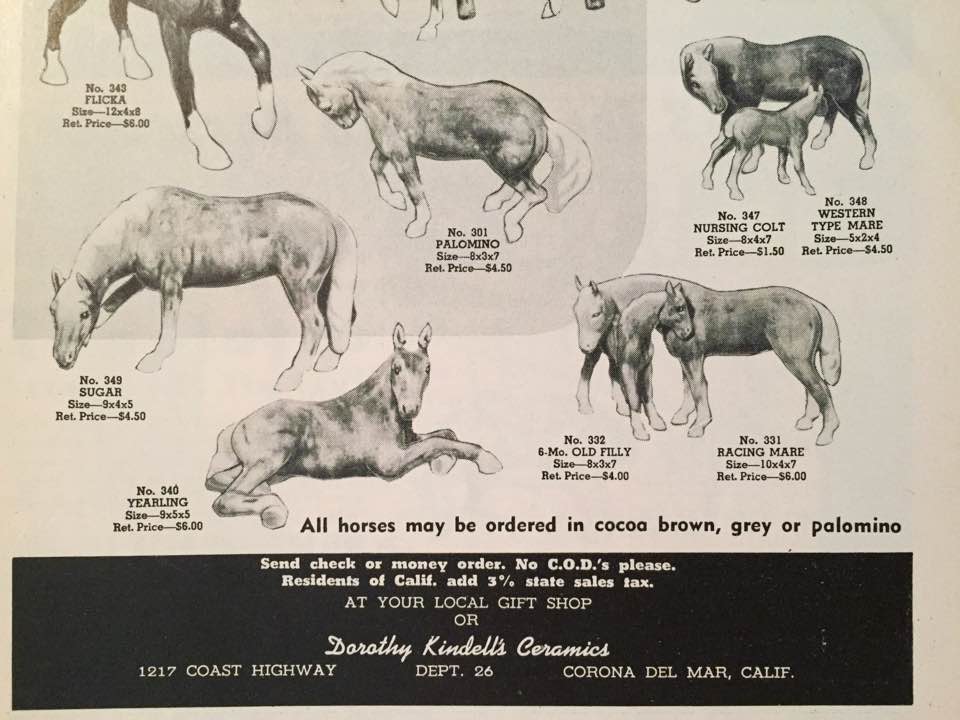
As any model horse collector will tell you, horse books and magazines and horse art are an integral part of the hobby. The images and stories help build our appreciation and understanding of real horses, which translate to the horse figurines in our collections. I recently learned quite a bit about polo in the 1930s.
Readers of this blog know that my favorite place to search for used model horses, old horse books and magazines, and vintage horse art is at an estate sale. Members of the Greatest Generation who are passing away or moving to smaller homes lived in a time when the horse was a much larger part of our daily lives. The items they collected and saved reflect the horse's importance.
So, periodically, I go online and search estate sale listings in my area for certain keywords -- "horse" and "pony"-- and for the names of horse authors and artists, such as "Gladys Brown Edwards," "Sam Savitt," and "Paul Brown."
The search engine is not intuitive. Usually, all I see are estate sale ads with pictures and descriptions of saw horses and two horse-power motors. Occasionally, I come across a sale that actually has what I'm looking for.
And, at one sale earlier this year, I found far more than I'd hoped.
I couldn't believe it, at first. The ad listed "Paul Desmond Brown Horse Art." I assumed that someone had collected some of Brown's highly-desirable lithographs of equestrian sports, or perhaps prints of his work, which would certainly have been worth seeing. I'd never seen anything by Brown at an estate sale. Whether I could afford them or not -- Brown's work is not inexpensive, and the sellers had even researched his middle name -- was another story.
After standing in line in the pre-dawn mist for a couple of hours, I entered the estate sale home and (after a few minutes' rather hectic searching) spotted a battered-looking art portfolio lying on a sofa. Inside were not prints, not lithographs, but four pieces of original Paul Desmond Brown Horse Art, showing polo players in action. Brown's hand-written notes on the lower part of each drawing contained the name "Boeseke."

I didn't even stop to breathe before taking all four to the cashier. They were affordable. I bought them.
When I came up for air, I looked around the sale more carefully. A couple of tables were covered in sterling silver and silver-plated trophies, some mixing bowl-sized, some small enough to be held in one hand; some with a single name. The larger, solid silver trophies were inscribed with several names, dates in the 1930s, the name of an equestrian event. And the name "E.J. Boeseke, Jr." was on all of them.
In a corner of a room in the back of the house were a handful of horse show ribbons and a dusty framed photo of a tall, slender man wearing jodhpurs and riding boots, standing next to a shorter man in a suit and hat. I assumed the tall man was Boeseke; the shorter one looked like photos I've seen of film studio titan Louis B. Mayer. I bought those, too, to help further my research. The picture, the ribbons, and the Paul Brown drawings, had passed down through Boeseke's family.

Driving home, I mused that E.J. Boeseke, Jr. must have been a major figure in the polo world, if Paul Brown made multiple sketches of him. My online research bore this out.
In the early 1930s, the Great Depression was at its height. Americans looked for inspiration, for escape from the grim economy. They looked for heroes. And -- perhaps we'd almost forgotten, perhaps we're too young to remember -- heroes could be found on the polo field.
 |
| A full-page story in the Detroit Free Press shows Elmer Boeseke and Red Ace in the center of the page. |
 |
| Elmer Boeseke and his horse Red Ace are shown at the top of the page, second from left, in this article in the (Tucson) Arizona Daily Star. |
 |
| The Daily Star's full-page spread on the popularity of polo featured a map of polo clubs around the country. |
Polo was a major sports attraction in the 1930s, and for a few sparkling years Elmer Julius Boeseke, Junior of Santa Barbara, California was one of a handful of men in the heart of it. Boeseke's father, Dr. E.J. Boeseke, Sr. and several other relatives were well-known polo players in Santa Barbara. The Museum of Polo website tells us Elmer Boeseke, Jr. was inducted into the Polo Hall of Fame in 1999.
The right man at the right time, Elmer Boeseke, Jr. was as tough as he was tall. Versatile in all four positions, his performance in the forever famed 1933 East-West duel was crucial to the West's victory and its newfound respect in polo. That memorable achievement also earned him a 10-goal rating in a single jump from 8-goals.
One of only three 10-goalers in his day, he played on the victorious U.S.A. squad in 1932 which won both the Cup of the Americas and the Argentine Open, a feat not realized since. He had a U.S. Open Championship to his credit, a Monty Waterbury trophy and countless other honors in Pacific Coast tournaments.
That 1933 East-West match became the stuff of polo legend. It was the lead story in the Chicago Tribune.

 |
| Elmer Boeseke appears on the far right in this photo. |
The tall and lanky Boeseke, also known as "Big Bo" and "the Babe Ruth of Polo" for his all-out, neck-or-nothing riding style, owned a number of polo ponies, but perhaps the most beloved and best-known was his chestnut off-track Thoroughbred gelding, Red Ace. The Polo Museum website's Horses to Remember section recalls:
Dr. E.J. Boeseke, Sr., found Red Ace at a Tijuana racetrack, brought him to California and trained him as a polo pony. In the East West match of 1933, with E.J. Boeseke, Jr., in the saddle, Red Ace won Best Playing Pony. But he is best remembered for a moment in the game when he won hearts as well. After Boeseke was knocked to the ground in a particularly rough play, Red Ace turned, trotted back, stood by his unconscious master and gently nuzzled him.
Prior to his memorable performances in the East West series, Red Ace played polo on both coasts in the U.S., in South America with a North American team, and in England. He was remembered by Seymour Knox as a “brilliant pony,” and by Thomas C. Nelson of Argentina as one of the best ponies he’d ever had anything to do with. He had great straightaway speed and great courage.
Red Ace routinely played two chukkers in a game, and Elmer Boeseke was one of the biggest and most hard-riding men in polo. In a 1934 article in the New York Herald Tribune, the writer noted, “When up on Red Ace, Boeseke’s game was of a higher standard. He seemed surer. He knew he could trust Red Ace.”
You can see the long-legged Boeseke, number 2 in the dark jersey, and Red Ace in this British Pathe' video archived on YouTube.
A Los Angeles Times staff artist did a portrait of Red Ace and two other polo ponies in 1934.

And a newspaper article of that not-so-long-ago day reminds us that Red Ace was also an award winning show horse.
 |
| Brooklyn Daily Eagle, 9.29.1934. |
A page of sketches in Paul Brown's book Hits and Misses shows the artist's note: "Boeseke's Red Ace: What a pony."
http://chisholmgallery.com/wpg2-2-2?g2_itemId=28992
I believe the ribbons Red Ace won at this and other horse shows, may have been the ones I found at the estate sale.
Oh -- you wanted to see the drawings, didn't you? Of course. Brown shows us Boeseke at the peak of his form in 1933. Somewhere in the crowds at the polo matches, we can imagine Paul Brown with his small pad of paper, pencil flying, trying to capture the essence of the action. Later, Brown would go back to his studio, review photos of the match, search his memory, and recreate these moments in equine history.
 |
Artist's notes:
Aurora vs Templeton - Practice 1933
5th period Iglehart hit up field and all
players started after ball. Boeseke waited
to stop ball and as he did so hooked it
up along side pony. Carried ball around
both teams and scored.
(signed) Paul Brown '34
"8th period Aurora Templeton Sept 1 Cochrane"
is penciled lightly in the lower right corner of the paper.
|
 |
| Artist's Notes: Penalty # One East vs West Chicago '33 Boeseke goes down. (signed) Paul Brown |
 |
| Artist's notes: Goal Boeseke vs Hitchcock East vs West Chicago 1933 8th Period 3rd Game (signed) Paul Brown |
 |
| Artist's notes: Finals Open Championship Aurora vs Greentree '33 5th period Over the boards headed for the club house -- pace terrific -- Boeseke vs Balding. Elmer hit a long one down and out on to the field. (signed) Paul Brown '34 |
But you can also see why I could not possibly have left them at the estate sale for someone else to purchase. This is the perfect combination in equestrian sporting art: the horses and riders at the top of their form, captured in exquisite, heart-stopping detail by the master.
You can sense Brown's excitement, his concentration mirrored in Boeseke's body language.

Brown shows us, capturing one split second of time, just how hard Boeseke is about to smack that unseen ball with his mallet.

With only a few well-placed lines, Brown shows us the other players rushing into focus as hard as they can pelt.

We experience a sharp intake of our collective breath, a collective gritting of our teeth, as Brown anticipates just how hard Boeseke and his horse are about to slam into the ground. The horse seems much more aware of their fate than the rider.

_________________________________________
Many thanks to Alexis Adkins at the W.K. Kellogg Arabian Horse Library at Cal Poly Pomona #WKKAHL for the recommendations for storing old paper, and to Brenda Lynn at the Museum of Polo, who told me that the old-timers pronounce Elmer's last name "bo-seek."
Additional resources:
M.L. Biscotti's book Paul Brown: Master of Equine Art does an excellent job of summarizing Brown's life, career, and style.
https://www.amazon.com/Paul-Brown-Master-Equine-Art/dp/1564162095An article by Arthur C. Liese on the Hurlingham Polo website honors Brown:
http://www.hurlinghampolo.com/backissues/spring_2016/files/assets/basic-html/page46.html
The Garden City (NY) News did a story on a recent exhibition on Brown:
The National Sporting Gallery and Museum has more than 200 of Paul Brown's works in its collection:
The Chisholm Gallery has a good summary of Brown's style and the scope of his work, and a dizzying array of images of his art: http://chisholmgallery.com/paul-brown
Some of Paul Brown's illustrations in ads for Brooks Brothers are shown here:
To read more about Elmer Boeseke:
And about Red Ace: http://www.polomuseum.com/hall-of-fame/horses-to-remember